

A new Subaru carries three prices, though only one of them is printed large enough to read from the sidewalk. The sticker in the window comes first, the sticker minus the money Subaru itself hands back comes second, and the contract after the dealer has added his own lines comes last. As the first of the three is the one no buyer pays, up or down, this piece works out the other two on a Forester bought in Jackson, Mississippi, where the one federal rule that would have printed all three on the window was thrown out by the local court. That ruling is dealt with further down.
Subaru’s own rebates take about $500 off the window price, and the dealer’s own fees can put several hundred back on, so the buyer who reads the second and third lines pays a different price from the buyer who reads the first.
Contents
- 1 Subaru Prints Its Own Coupons, Though It Prefers To Call Them Programs
- 2 Share The Love Runs Each Winter, And That Is Why December Is The Cheap Month
- 3 The Dealer Writes Three Numbers Himself, And Mississippi Caps None Of Them
- 4 Forester Or Forester Hybrid, Worked Out On Jackson Gas
- 5 A Jackson Buy, Added Up In The Order The Finance Office Adds It
- 6 Quick Test
Subaru Prints Its Own Coupons, Though It Prefers To Call Them Programs
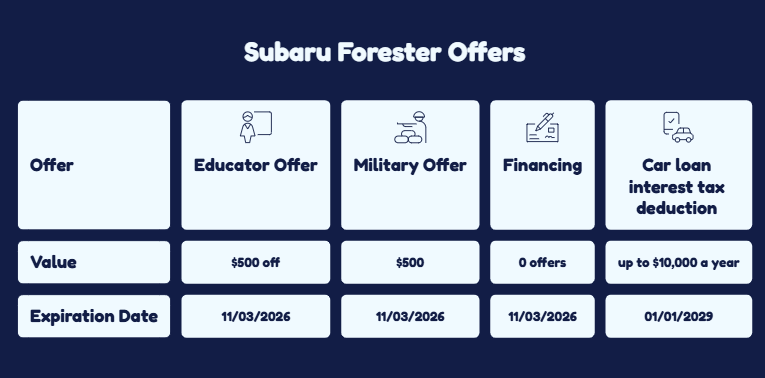
Whoever opens Edmunds on the 2026 Forester finds the offers laid out much as a coupon site lays out its codes, each with a condition attached and a date on which it expires. These were the ones showing when I checked, all of them ending 11/03/2026:
- Educator Offer: $500 off for active PreK-12 classroom teachers, on a cash purchase, a finance deal or a lease.
- Military Offer: $500 for active duty, reserve, veterans and retirees within 24 months of separation.
- Financing: 0 offers available on the Forester at the time of checking.
- Car loan interest tax deduction: up to $10,000 a year in interest on a new U.S. assembled vehicle, running to 01/01/2029, with leases excluded.
Teachers seldom know about the first line, and until this piece I had never checked it myself. A teacher who bought a Forester last year without asking paid whatever figure the salesman settled on that afternoon, while $500 with her job title on it sat on a public page the dealer need not mention unless she does.
Since these offers attach to a car and never to a brochure, you ought to open the subaru models the dealer is holding on the lot, pick a VIN, and have the rebate written against that VIN. Should the dealer say he does not participate, as the Edmunds page warns he may, ask at once for the one who does, for participation is merely a choice the dealer has made, and a choice is the one item on the lot he can be asked to change.
The deduction deserves its own paragraph, being the largest figure on the list and the easiest to lose. Does the Forester qualify? It depends on which Forester is standing in front of you, as the deduction covers vehicles assembled in the United States and Subaru assembles in two countries. Look at the first character of the VIN on the window sticker before you look at anything else:
- 4 means the car was built in Indiana.
- J means the car was built in Japan.
Two Foresters of one trim and one color can sit side by side in one showroom, and the one whose VIN begins with 4 earns its owner up to $10,000 a year in deductible interest, whereas the other earns him nothing beyond a nice car. Do check that character before the paint has made the decision for you.
Subaru’s own release for last winter gives the dates as November 20 to January 2, and under the program Subaru gives $250 to a charity of the buyer’s choosing for each new car sold or leased, while the dealer adds at least $50 more to a local cause. Close to $320 million has gone out this way since 2008, by Subaru’s count, and I have no reason to doubt the figure.
What the release leaves out is the calendar. The window falls across the last six weeks of the sales year, when dealers are working against quotas that must be met by December 31, and the $250 goes to the ASPCA or Make-A-Wish just as surely if you haggle hard as if you do not. The donation, then, is Subaru’s gift. The quota is yours to use.
Buy inside the Share the Love window and you get two things, the charity line on the paperwork and a December salesman across the desk, of which the second is worth more to you.
The Dealer Writes Three Numbers Himself, And Mississippi Caps None Of Them
At this point the brochure has nothing further to say, because three lines on the contract were never on the sticker and the dealer wrote all three:
- The doc fee. Illinois caps it at about $350 and California at about $85, whereas Mississippi sets no cap at all, and the guides that track the figure put the usual Mississippi charge somewhere between $300 and $800. As no law fixes it, you may argue it.
- The add ons. Nitrogen in the tires, paint protection, a protection plan. Paul Moak’s own site lists Vehicle Protection Options and genuine accessories such as floor mats and roof racks, and that is the open version of the practice, yet open or hidden each one remains a line you are entitled to decline.
- The market adjustment. It appears only when a model is scarce, and it is the dealer’s own number with nothing behind it except the length of the queue.
Open any dealer’s listing on your phone, whatever the brand, and scroll until you reach the price. Beneath it, printed scarcely larger than a crumb, sits an asterisk, and that asterisk is where the second and third prices of this article live. Had the dealer wanted you to read them, he would have used the type size of the price above.
Are you with me so far on the three lines? Good, because the next part explains why they are still hidden.
The Rule That Would Have Printed Those Three Lines Was Thrown Out In Mississippi’s Own Court
The Federal Trade Commission wrote a rule, known as the CARS rule, under which a dealer would have had to show the full price in one figure, mark each add on as optional and obtain the buyer’s agreement to it, and stop advertising any price that was not available on the lot. That was the extent of it.
The dealer trade bodies, the national one and the Texas one, took the rule to the Fifth Circuit, and on January 27, 2025 the court set it aside by two votes to one, on the ground that the FTC had skipped a notice step in its own rulemaking. The judges never reached the fees themselves, as the rule had already fallen on procedure before they could.
Because the Fifth Circuit covers Texas, Louisiana and Mississippi, a Jackson buyer stands in the first part of the country where that rule was struck down, and the asterisk remains on the listing for no better reason than that a form was missed in Washington. The dealers won the case fairly, as far as the law goes. Was the buyer served by it? That is a different question, and I would answer no.
Forester Or Forester Hybrid, Worked Out On Jackson Gas
Although Subaru seldom moves a price by more than a couple of hundred dollars, it cut the 2026 Forester range across the trims in February, so that the Premium Hybrid now carries $34,730 on the sticker, or $36,180 once the $1,450 destination charge has been added, and that is lower than the figure your neighbor paid for last year’s model. It is an unusual position from which to begin a haggle, and a good one.
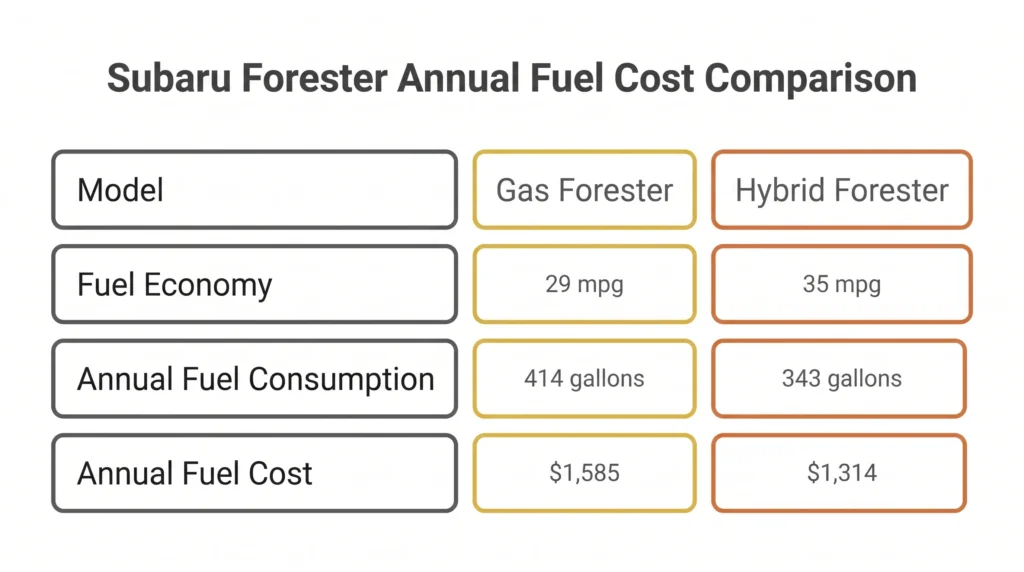
The gas Forester returns 29 mpg combined, the Hybrid returns 35, and gas in Jackson stood at $3.83 this week. Most buyers compare sticker with sticker and leave the fuel out of the sum altogether, the classic hybrid mistake, so the lines are set out below:
- 12,000 miles at 29 mpg is 414 gallons, about $1,585 a year.
- 12,000 miles at 35 mpg is 343 gallons, about $1,314 a year.
- The Hybrid therefore saves about $270 a year on Jackson gas.
Your part comes next. Take the two stickers in front of you, the gas Premium and the Hybrid Premium, and divide the gap between them by 270:
- A gap of $2,700 means the Hybrid repays itself in 10 years.
- A gap of $1,400 means 5 years.
The sticker gap decides the matter, and the dealer sets that gap on the day, since Subaru sets only the sticker.
Tell me your number. Most people find that the years come out longer than they intend to keep the car, in which case the Hybrid is a comfort purchase, and no shame attaches to a comfort purchase provided it is bought as one and never mistaken for a saving.
A Jackson Buy, Added Up In The Order The Finance Office Adds It
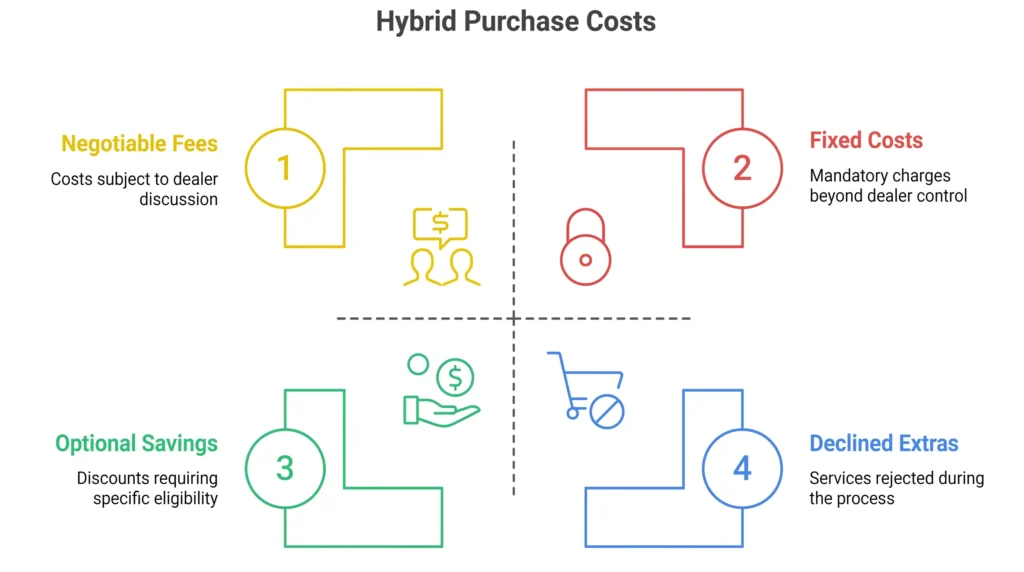
Take the Premium Hybrid at $34,730 and let the money walk onto the contract in the finance office’s order, never the order you had in your head, and that difference in order is where the extra money comes from:
- Destination, $1,450, belonging to Subaru and beyond negotiation, since the truck must be paid.
- Teacher or military rebate, minus $500, provided you have one and asked for it.
- Mississippi sales tax at 5% of the sticker, about $1,740, to which some cities and counties add a little.
- Title $9, registration about $14.
- Doc fee, whatever the dealer names and whatever you name back, call it $400 after the conversation.
- Add ons, $0, because you declined them, twice.
You walk in looking at $34,730 in the window and you walk out having signed for about $37,850. Of that $3,100 gap, nearly all is tax and the delivery truck, and no salesman on the lot has the power to move those two. Only the $400 was ever yours to argue, and you argued it, and only the $500 was Subaru’s to give, and you asked for it.
Quick Test
One Forester, three prices on it:
- The sticker in the window.
- The sticker minus Subaru’s rebates.
- The contract after the doc fee and the add ons.
Which of the three did you pay last time, and had you read the third before you read the first?

