

This information is for harm reduction only – not promotion. Delta-8 THC is psychoactive, potentially addictive, and illegal in many states. It impairs driving, shows up on drug tests, and has unknown long-term health effects. If you’re considering using any cannabis product for medical reasons, consult a doctor. For recreational purposes, consider that Delta-8 is largely unregulated, often contaminated, and carries legal risks. This guide exists because people are using it anyway and need safety information to avoid hospital visits.
Since the legalization in many states of Delta-8, interest in the product has increased, That’s Why I felt responsiblity to illustrate this!
Contents
First-Time Usage Guidelines
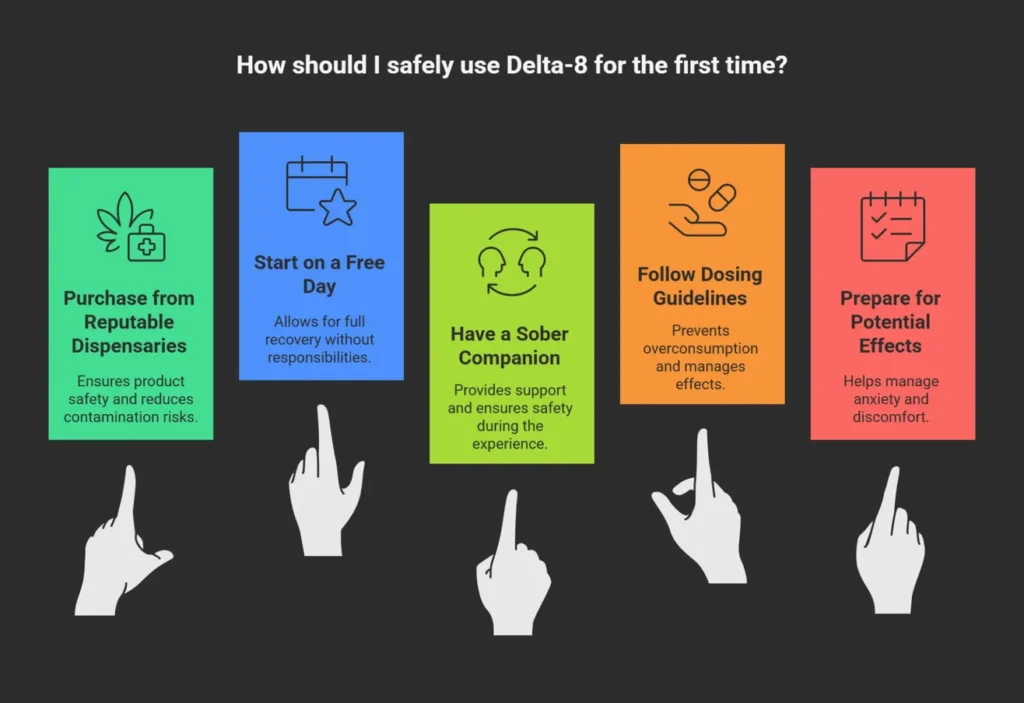
Before You Start:
- Buy only from dispensaries that provide third-party lab tests showing contaminant levels.
- Most Delta-8 is synthesized from CBD using acids – contamination is common.
- Start on a day with zero responsibilities for the next 24 hours.
- Have a sober person with you who knows you’re trying Delta-8.
- Don’t drive for at least 12 hours after use, longer if you still feel effects.
Dosing for First-Timers:
- Gummies/edibles: Start with 5-10mg maximum, wait 2 full hours before taking more.
- Vaping: Take one 3-second puff, wait 15 minutes to assess effects.
- Never take more because you “don’t feel it yet” – onset can take 2 hours for edibles.
- Delta-8 is roughly 50-75% as potent as regular THC but affects everyone differently.
- Your first time won’t build tolerance – the same dose might hit harder next time.
What to Expect:
- Mild euphoria, altered perception, increased appetite.
- Possible anxiety, paranoia, rapid heartbeat, dry mouth, red eyes.
- Effects last 3-8 hours depending on consumption method.
- You might still feel “off” the next day – don’t drive if you feel impaired.
- Some people experience nausea or vomiting, especially with higher doses.
Safety Preparation:
- Keep water, snacks, and a comfortable place to lie down ready.
- Write down what and how much you took, including the time.
- If anxiety hits: remember it’s temporary, focus on breathing, drink water.
- Emergency rooms see Delta-8 overdoses weekly – call 911 if someone’s unresponsive.
CBD as an Alternative
CBD and Delta-8 are completely different despite coming from hemp. CBD is non-psychoactive – it won’t get you high. Delta-8 is psychoactive – it will impair you like marijuana.
CBD affects the body without intoxication. It might reduce anxiety, inflammation, or seizures in some people. You can drive on CBD (though it’s wise to know how it affects you first). CBD typically won’t show on drug tests unless it contains THC contamination.
Delta-8 binds directly to CB1 receptors in your brain, causing intoxication. CBD doesn’t bind to these receptors strongly. Taking CBD is like taking aspirin – you might feel better but you’re not impaired. Taking Delta-8 is like drinking alcohol – you’re definitely impaired.
Many people trying Delta-8 for anxiety or pain would get similar benefits from CBD without the legal risks, impairment, or addiction potential. CBD is also federally legal, while Delta-8’s legality is questionable.
Each has its effects, ranging from relaxation to euphoria. CBD is often associated with calming feelings and increased ease. Both Delta-8 users, as well as marijuana users, experience similar effects.
- Joyful emotions
- Relaxation.
- Anxiety stimulant.
- You will get a restful night’s sleep.
- In some instances, pain relief is possible.
Delta-8 has the lowest THC levels, which makes it less potent. Delta-8 takes 30 to 60 minutes to take effect.
Is Delta-8 Legal?
Delta-8 exists in a legal gray area. The 2018 Farm Bill legalized hemp-derived products containing less than 0.3% Delta-9 THC. It didn’t mention Delta-8 specifically. Some argue this makes hemp-derived Delta-8 legal federally. The DEA says synthetic cannabinoids remain Schedule I controlled substances. Since most Delta-8 is synthesized from CBD, not extracted directly, it might be considered synthetic.
Delta-9’s THC content means that it will likely show up in a drug test. Delta-8 shares the same chemical structure and is expected to show positive results.
For more information on Delta 8, click here.
- States Where Delta-8 is Explicitly Illegal: Alaska, Arizona, Arkansas, Colorado, Connecticut, Delaware, Idaho, Iowa, Kentucky, Michigan, Mississippi, Montana, Nevada, New York, North Dakota, Oregon, Rhode Island, Utah, Vermont, Washington.
Why These States Banned It:
- Colorado and Washington have legal marijuana markets – they banned Delta-8 because it’s unregulated and untested.
- Idaho and Mississippi banned it for being psychoactive despite hemp being legal.
- New York banned it due to contamination concerns – tests found heavy metals and acids.
- Michigan banned it after poison control calls increased 500% in one year.
States Where It’s Legal (for now): California, Florida, Georgia, Illinois, Indiana, Maine, Maryland, Massachusetts, Minnesota, Missouri, Nebraska, New Hampshire, New Jersey, New Mexico, North Carolina, Ohio, Oklahoma, Pennsylvania, South Carolina, South Dakota, Tennessee, Texas, Virginia, West Virginia, Wisconsin, Wyoming.
But “legal” doesn’t mean safe or regulated. Texas and Florida have age restrictions. Some states require testing. Many states are currently considering bans. Check current laws before purchasing – they change monthly.
Is Delta-8 Safe?
Short answer: we don’t know. Delta-8 occurs naturally in tiny amounts in cannabis. The Delta-8 being sold is synthesized from CBD using chemical processes. No long-term studies exist on synthetic Delta-8’s safety.
Known Risks:
- Contamination is widespread – tests find residual acids, heavy metals, unknown compounds.
- Unregulated production means no standards for purity or potency.
- Products often contain way more or less Delta-8 than labeled.
- Some products contain Delta-9 THC, making them federally illegal.
- Synthetic cannabinoids have caused deaths – we don’t know if Delta-8 could too.
Immediate Health Risks:
- Emergency room visits for Delta-8 increased 2000% from 2020 to 2022.
- Common ER presentations: extreme anxiety, psychosis, vomiting, heart palpitations.
- Children accidentally consuming Delta-8 gummies is increasingly common.
- Some users report seizures, though causation isn’t proven.
Drug Testing: Delta-8 absolutely shows up on drug tests. Standard marijuana tests look for THC metabolites – they can’t distinguish between Delta-8 and Delta-9. If you use Delta-8, you will fail a drug test for marijuana. This metabolite stays detectable for:
- Single use: 3-4 days
- Weekly use: 7-14 days
- Daily use: 30-90 days
Telling your employer it was “legal Delta-8” won’t help. Most employers have zero-tolerance policies for any THC metabolites. You can lose your job, custody rights, or face legal consequences even in states where Delta-8 is legal.
The military, DOT, healthcare workers, anyone with CDL licenses – Delta-8 use violates federal drug-free workplace requirements regardless of state laws.
Is Delta-8 Detected in a Drug Test?
After use, the THC content in any amount remains in your body. THC detection time varies according to the amount of THC consumed and the frequency of consumption. According to American Addiction Centers (AAC), THC can be detected at different times depending on the type and quantity of samples.
- Hair samples are available for up to 90 days
- The saliva sample can be kept for up to 48 hours.
- In urine samples, it can take up to three days or more.
- During blood tests, it can take up to 36 hours.
