

Virtual Dating Trends Global Online Dating Population: The global online dating population was approximately 349 million in 2023, with the industry expected to grow significantly.
Dating has changed big time in the last 10 years. We went from basic chat rooms and simple websites to this huge industry that keeps changing how we meet people. Those 349 million people using dating apps aren’t just numbers – they show how differently we connect with each other now.
Remember when telling your friends you met someone online was kind of embarrassing? Just 15 years back, you’d lower your voice when mentioning it. Now it’s just normal. Before apps took over our phones, people used newspaper ads, went to speed dating, or hoped friends would set them up. Meeting someone meant hitting bars or waiting for your social circles to cross paths with someone compatible.
COVID changed everything faster. When bars closed and everyone stayed home, dating apps exploded. Apps saw messages increase 10-30% during lockdowns. Video dating, which nobody really used before, became super important. Hinge, Bumble, and Tinder all added video calls, and people started doing “pre-date” video chats to check each other out before meeting up.
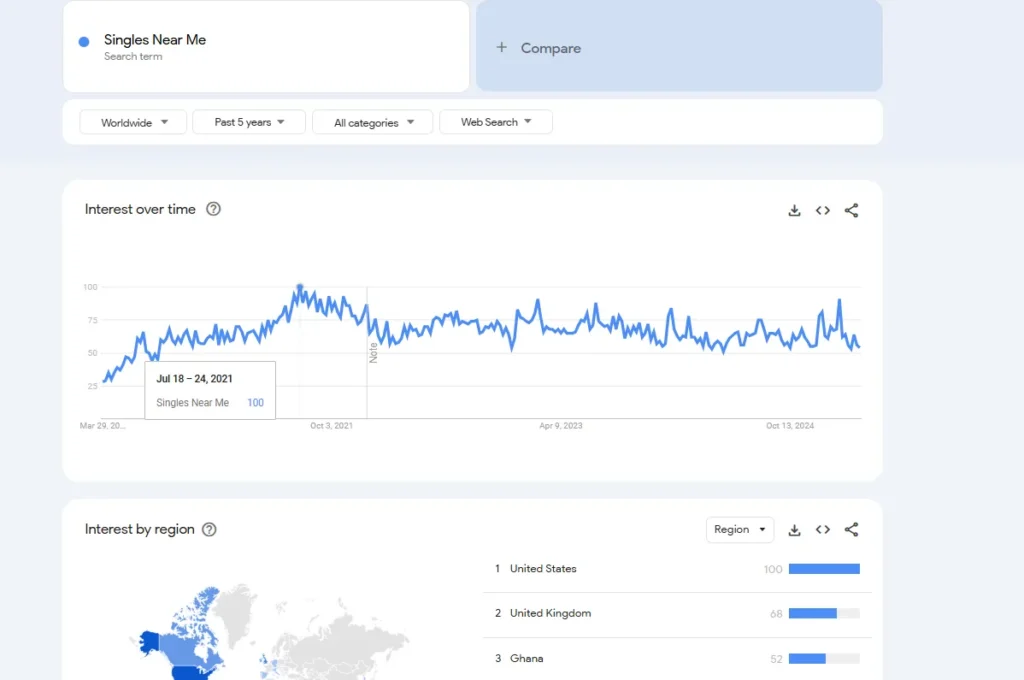
Location doesn’t matter as much now either. Before, apps mostly showed you people nearby who you could actually meet. Now many apps let you match with people anywhere. Some users specifically look for relationships with people in other countries, while others just like talking to people from different places without expecting anything romantic.
Contents
Market Size And Demographics
Market Size: The online dating industry had a market size of $9.65 billion in 2022 and is projected to grow by 7.4% CAGR between 2023 and 2030.
The money in dating apps is huge and getting bigger fast. Almost $10 billion in 2022, and set to grow over 7% yearly through 2030. That’s not just people looking for love – that’s serious business.
Tinder dominates with younger folks – 79% of users aged 18-29 have swiped through it. But the whole online dating scene kept growing even after COVID lockdowns ended. By 2023, about 30% of all U.S. adults were using dating apps, with over half of young adults (53%) swiping and matching.
Video dating stuck around too. Bumble saw video calls jump 70% during 2020, and by 2024, about 40% of users had tried video dates. People like checking each other out on screen before meeting in person – saves time and awkward coffee dates.
The numbers keep climbing. Statista predicts the global market will hit $3.17 billion in 2025, with user numbers reaching 462.5 million by 2029. A big chunk of this growth comes from new features like video chats and VR experiences that keep users engaged. According to Octal Software’s 2024 report, VR dating could boost user engagement by 46% over the next five years. That’s massive growth ahead.
A Safe and Comfortable Experience
Safety is a significant concern when meeting new people. Virtual dating removes the risks associated with in-person meetings. Participants can interact without worrying about physical safety. This setup provides a comfortable space for meaningful connections. More people feel secure using online platforms for dating.
Having control over interactions builds confidence. Participants can decide whom they want to continue talking to. Blocking or reporting features provide additional security. No one feels pressured to share personal information immediately, and this level of protection encourages more individuals to explore it.
Traditional dating often requires multiple outings before finding a potential match. Online speed dating accelerates this process. Participants can interact with several individuals in a single session, and this fast-paced experience helps people find compatible matches efficiently. More conversations mean more chances to meet the right person.
Short interactions allow people to focus on first impressions. A few minutes are enough to determine essential compatibility. If two people connect, they can arrange more extended conversations later. This format eliminates the awkwardness of prolonged first meetings, and more singles appreciate its efficiency.
A Safe and Comfortable Experience
Safety Concerns: Only 48% of U.S. adults feel it is at least somewhat safe to date online. Less than half of U.S. adults think online dating is safe. That’s a problem, but virtual dating actually solves another big issue – the anxiety of approaching strangers.
Think about this scenario: Tim is a software developer who freezes up trying to talk to new people. The thought of walking up to someone at a bar makes his palms sweat. With dating apps, he can create his profile while comfortable at home, think about what to say, and send messages without the immediate pressure of someone staring at him waiting for words.
Video dating takes this a step further. Tim can chat from his own space where he feels secure. No worrying about picking the right meeting spot or how to say goodbye if things don’t click. He can ease into conversation without the overwhelming sensory experience of a crowded restaurant.
For people with social anxiety, this is game-changing. They can build confidence gradually. Many users report feeling more authentic online first – they focus on the conversation rather than how they look nervous or if they’re fidgeting too much.
The safety advantage works both ways too. Women especially appreciate screening potential dates through video before meeting in person. If someone gives off bad vibes during a video call, they can end things without worrying about how to exit an uncomfortable situation in public.
Virtual dating creates a middle ground between totally online interaction and the high-pressure in-person first date. For introverts and anxious folks, it’s not just convenient – it’s a way to date that actually works with their personality instead of against it.
The Sudden Rise of AI Dating
Suddenly our feeds were flooded with AI girlfriends. You’d be scrolling through Instagram and there she was – a perfectly rendered woman with big eyes promising to “always be there for you” or “never judge you.” Facebook ads showed men laughing with virtual women who somehow always found them hilarious. These AI companions were everywhere, seemingly appearing overnight.
What’s weird is I never saw AI boyfriends targeting women in my feeds. None of my female colleagues mentioned chatting with AI men. My guy friends, though? Several admitted they’d “just tried it for fun” or were “curious about the technology.” The marketing clearly targeted men, playing on loneliness, desire for uncomplicated companionship, or just plain curiosity.
Then Snapchat dropped their AI feature, and everyone knew exactly what it was for. No one was pretending it was about deep philosophical conversation. The knowing smirks when someone mentioned “chatting with their Snapchat AI” said it all. It was understood these were intimate, often sexual conversations that users wouldn’t want others to see. Snapchat just made it mainstream what niche apps had been doing for years.
Growing Market and User Base
Dating Trends:
- AI Girlfriend Market: The global AI Girlfriend market was valued at $2.8 billion in 2024 and is projected to reach $9.5 billion by 2028.
- Search Trends: Google searches for “AI Girlfriend” increased by 2,400% between 2022 and 2024, indicating a significant rise in interest.
- User Engagement: 55% of users interact with their AI girlfriends daily, showing high engagement levels.
- Demographics: One in five men on dating apps have tried AI Girlfriend platforms at least once.
That’s not just growth – it’s an explosion. From $2.8 billion to $9.5 billion in just four years? Search interest jumping 2,400%? These numbers aren’t just showing a trend; they’re showing a revolution in how some people approach relationships.
The daily engagement is what really stands out. More than half of users talk to their AI girlfriends every single day. That’s higher engagement than many social media platforms achieve. And with one in five men on dating apps having tried these AI platforms, it’s crossed over from niche curiosity to mainstream option.
The Appeal and Limitations
Why are so many guys turning to AI companions? The obvious answers are there – they’re always available, never argue, and can be programmed to find you endlessly fascinating. For men struggling with rejection or social anxiety, the appeal is clear.
These AI girlfriends offer a risk-free environment to practice conversation or express feelings without fear of judgment. For some users, it’s about having someone – even a digital someone – to share thoughts with at the end of a long day. The programming has gotten sophisticated enough that these interactions can feel genuinely supportive.
As an observer of this trend, I think we’re looking at a temporary bubble – but maybe not as temporary as we’d like to believe. These AI relationships lack authentic emotional connection. They can simulate empathy but can’t actually feel it. They remember your preferences but don’t really care about them. The conversation is ultimately hollow because only one participant has real consciousness.
But then again, sex dolls are a massive industry despite having zero emotional capacity. They’ve only gotten more sophisticated (and expensive) over time. The market for artificial companionship, physical or digital, seems to be growing regardless of the philosophical limitations.
Perhaps what we’re seeing is just the beginning of something that will integrate more deeply into society than we expect. As AI advances, the line between “real” and “simulated” interaction gets blurrier. Maybe in ten years, we’ll be having completely different conversations about what constitutes a relationship.
What’s certain is that AI dating isn’t just a curiosity anymore. It’s a billion-dollar industry addressing real human needs for connection, even if it’s doing so in a way that raises as many questions as it answers. Whether this is a stepping stone toward better human relationships or a replacement for them remains to be seen.

I do believe all of the ideas you have presented for
your post. They are very convincing and can definitely work.
Nonetheless, the posts are too short for beginners. May you please extend them
a bit from next time? Thank you for the post.
It’s actually a nice and useful piece of
info. I’m happy that you shared this helpful info with us.
Please stay us informed like this. Thanks for sharing.
whoah this weblog is fantastic i really like studying your posts.
Stay up the great work! You recognize, many people are looking around for this
information, you could help them greatly.
Hi everybody, here every person is sharing these kinds of knowledge, therefore it’s
good to read this web site, and I used to pay
a quick visit this web site everyday.
Thankfulness to my father who shared with me on the
topic of this webpage, this blog is really amazing.
It’s in reality a great and useful piece of info. I’m glad that you simply shared this helpful
info with us. Please stay us informed like this.
Thank you for sharing.
It’s an remarkable post in support of all the internet users; they will get benefit from it I am
sure.
What’s up, of course this piece of writing is genuinely fastidious and I
have learned lot of things from it regarding
blogging. thanks.
When someone writes an piece of writing he/she retains
the plan of a user in his/her mind that how a user can be aware of it.
Therefore that’s why this article is amazing. Thanks!
Good post! We are linking to this particularly great post on our site.
Keep up the good writing.
Hello to every , as I am really eager of reading this website’s
post to be updated on a regular basis. It contains good data.
Greetings! Very useful advice in this particular article!
It is the little changes that make the greatest changes. Thanks for sharing!
What’s up, I log on to your new stuff daily.
Your writing style is awesome, keep doing what you’re doing!
I am regular visitor, how are you everybody? This post posted
at this website is actually good.
I was able to find good information from your blog articles.
I do not even know how I ended up here, but I thought this post was great.
I don’t know who you are but certainly you’re going to
a famous blogger if you are not already 😉 Cheers!
Very good site you have here but I was curious about if
you knew of any message boards that cover the same topics discussed in this article?
I’d really like to be a part of community where I can get feed-back from other
experienced individuals that share the same interest. If you have any suggestions, please let
me know. Thanks!
Oh my goodness! Awesome article dude! Many thanks, However I am going through troubles with
your RSS. I don’t understand why I cannot join it.
Is there anybody having similar RSS issues? Anybody who knows the solution can you kindly respond?
Thanx!!
Excellent article. Keep posting such kind of info on your
site. Im really impressed by your blog.
Hi there, You’ve done an excellent job. I’ll definitely digg it and for my part
suggest to my friends. I am sure they’ll be benefited from this site.
I’ve been browsing online greater than three hours these days, but I never
found any interesting article like yours. It
is lovely value sufficient for me. In my opinion, if all web owners and bloggers made just
right content material as you probably did, the internet might be a lot more helpful than ever before.
I’ve been browsing on-line more than 3 hours today, yet I never found any fascinating article like yours.
It’s pretty value enough for me. In my opinion, if all web owners
and bloggers made just right content material as you probably did, the net can be much more helpful than ever
before.
Hi there! Do you know if they make any plugins to assist with
SEO? I’m trying to get my blog to rank for some targeted keywords but
I’m not seeing very good success. If you know of any
please share. Cheers!
Hello there! Do you use Twitter? I’d like to follow you
if that would be ok. I’m definitely enjoying your blog and
look forward to new posts.
I have been surfing on-line greater than three hours these days,
yet I never discovered any interesting article
like yours. It is lovely price enough for me. In my view, if all
web owners and bloggers made excellent content material as you did,
the net might be much more useful than ever
before.
Normally I don’t learn post on blogs, but I wish to say that this write-up very pressured me
to try and do so! Your writing taste has been surprised me.
Thank you, very great article.
Wow that was unusual. I just wrote an really long comment but
after I clicked submit my comment didn’t appear.
Grrrr… well I’m not writing all that over again. Anyway, just wanted to say excellent blog!
Keep on writing, great job!
Simply want to say your article is as amazing. The clarity in your
post is just excellent and that i can assume you are knowledgeable on this subject.
Fine with your permission let me to take hold of your RSS feed to stay updated with impending post.
Thanks 1,000,000 and please continue the enjoyable work.
I am curious to find out what blog platform you have been using?
I’m experiencing some small security issues with my
latest blog and I’d like to find something more safeguarded.
Do you have any recommendations?
Excellent way of explaining, and pleasant article to obtain facts concerning my presentation subject
matter, which i am going to deliver in university.
My family members all the time say that I am killing my
time here at web, but I know I am getting experience all the time by
reading such good articles or reviews.
Terrific work! That is the kind of info that are
meant to be shared across the net. Disgrace on Google for not positioning this put up higher!
Come on over and seek advice from my website .
Thank you =)
Awesome blog! Do you have any suggestions for aspiring writers?
I’m planning to start my own site soon but I’m a little lost on everything.
Would you advise starting with a free platform like
Wordpress or go for a paid option? There are so many choices out there that I’m totally confused ..
Any suggestions? Many thanks!
This article is truly a pleasant one it helps new the web viewers, who are wishing in favor of blogging.