

Do you aspire to establish a career in commerce? Or thinking about trying your luck in commerce? You might be wondering what it takes to succeed in this field. While many people focus on finding the right job title or industry sector, what really matters are the abilities you bring to the table.
We all know after AI and fast tech evolution, the business world today moves quickly, with new technologies and market changes happening all the time. Having the right mix of practical knowledge and personal qualities will help you adapt and grow, no matter which specific role you choose to pursue in commerce. Indeed a career in commerce provides many opportunities, ranging from finance and accounting, marketing, business management, and even entrepreneurship. If you wish to be in a large corporate house, be a financial manager at a bank, or own your own fashion brand, the options are literally limitless.
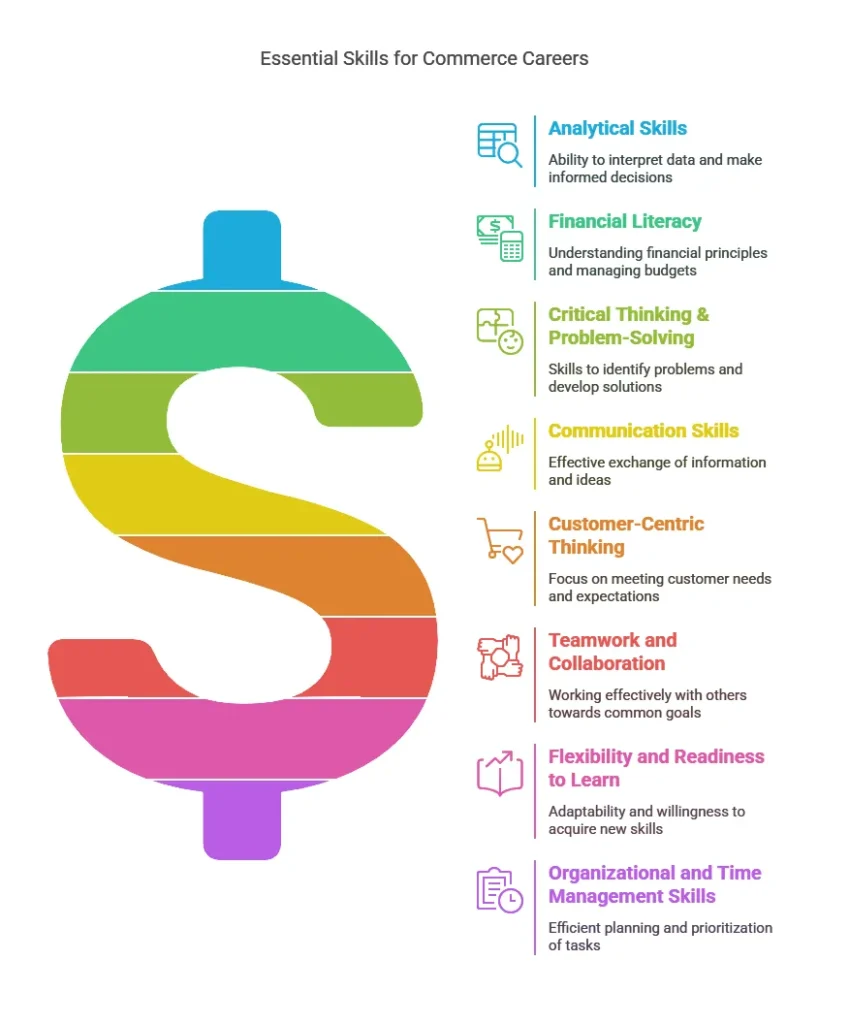
But, the catch here is that success in business does not necessarily mean holding a degree. It’s simply a matter of establishing a strong skill set so that you’re valuable and versatile in the changing landscape of business. So, what are those skills, exactly? Let’s dive in and discuss the basic skills you’ll need to succeed in a career in commerce.
Contents
Analytical Skills
Commerce professionals are required to possess a myriad of skills, however, analytical skills are arguably the most sought-after. As per the LinkedIn Workforce Reports and World Economic Forum (WEF) research, almost every commerce-related profession, including marketing, finance, and supply chain management, requires data analysis and its related skills. This is not by chance – in our contemporary economy that is driven by information, businesses need to interpret data effectively in order to succeed.
In the current business world, professionals are encountered with a plethora of data on a daily basis. Sales figures, stock levels, market trends, and consumer behavior patterns are just some of the data that is incredibly valuable to a business’ strategic decision-making. Raw data, however, is of limited value on its own. It is the ability to extract meaning that, identifying patterns, drawing conclusions, and taking action that gives the company a competitive edge.
Commerce analytics is not just analytics or counting. It involves thinking outside-the-box, including all relevant variables, and crafting solutions for complex situations step by step. Looking beyond the numbers is mandatory, and professionals need to understand the relationships between different data points and the many different outcomes that their actions could have.
Analytical abilities, such as campaign evaluation, audience targeting, and ROI calculation, are essential to marketing professionals. In finance, these skills assist in forecasting financial statements, assessing risks, and analyzing investments. Supply chain professionals use advanced analytical skills when estimating cost-effective inventory levels, optimizing transportation, and enhancing operational activities.
The evolution of commerce brought the digital age and advanced analytic capabilities. E-commerce sites track comprehensive data related to customer activity, including browsing and purchasing habits. Their social media accounts provide reputation and sentiment analysis. POS (Point of Sale) systems capture detailed data that help in recognizing purchase trends and inventory requirements.
The ability to articulate conclusions is also an analytic skill. Commerce experts must be able to provide actionable insights based on complex data interpretations to clients with no technical background. The insight-action divide is filled by this communication aspect.
Critical thinking is another characteristic of analytic skills in commerce. Specialists have to check how reliable a particular data source is and identify underlying biases in data analyses. This approach allows the concluding results from different evidences provided to be complete and accurate, ensuring decisions are not made based on misleading conclusions.
With the development of technology such as AI and machine learning, it is evident that these tools have, and will in the future, impact the ways people conduct analyses. AI may analyze datasets at fast rates, however, human appraisal includes reasoning and ethical components that are critical for justifiable decisions.
Case Study: The Tale of Two Merchandise Planners
Let’s consider Sarah and Michael, who are both merchandise planners for a retail chain of moderate size. While they both hold approximately the same degrees and years in the business, their ways of thinking analytically are very dissimilar which hugely impacts the entire performance of their individual departments.
Data analytics is one example of a primary intelligence that is very much needed in the modern business environment and must be learned in the course of study. For this case in hand, lets take a look at Sarah, who incorporated all forms of multidimensional thinking analyzing all quarters and their sales at retail. She does not stop at just the total revenue figure, she goes deeper, analyzing how various categories of products, stores, timings and customer profiles performed in terms of sales. For example, she comes to realize that some home goods are doing exceptionally well in suburban location stores on weekends and simply being terrible in urban ones during the weekdays.
Instead of jumping to conclusions, Sarah examines information more thoroughly. She uses marketing intel, seasonal changes, and competitor prices to pinpoint discrepancies. She determines that weekend suburban shoppers are engaging with a specific lifestyle marketing campaign that urban weekday customers do not connect with. Also, Sarah perceives that urban stores stock these items in low customer traffic areas.
These findings allows her to propose strategic marketing changes for urban settings, which she negotiates with store managers to enhance product visibility. As a result, urban sales of these items experienced a 22% increase relative to the previous two months, while sales in the suburbs remained steady.
In contrast, Michael adopts a more shallow approach to analysis. During the evaluation of his department’s data, he tends to fixate on the total sales numbers and year-on-year analysis. He observes that some clothing lines have reduced sales relative to the previous year and suggests price cuts as an immediate solution for increased sales.
What Michael overlooks are the evolving customer segments within his geographic area of focus, shifts in seasonal spending patterns, and the effects posed by newly entering competitors. His pricing strategy using discounts increases volume of sales temporarily not profit margin. Furthermore, he does not make an attempt to resolve the primary factors driving the performance issue; the outdated preferences of his clientele and the stale assortment of merchandise offered.
Three months later, while Sarah’s department is performing exceptionally well in both sales and profits, Michael’s department is struggling with lower margins and unbalanced inventory levels. The difference? The rudimentary skills of data analysis combined with the proper data enabled Sarah to address the root causes instead of focusing on the symptoms presented.
Importance of Critical Thinking Skills in Business:
- Allows judges to sift through and evaluate evidence prior to arriving to a conclusion towards a decision.
- Ensures early identification of neglected trends that can be beneficial if exploited by competitors.
- Minimizes financial risk by providing sophisticated analysis, clearer forecasting, and more precise scenario planning.
- Allows focus to be directed to high performing areas while spending resources highlighting underperforming opportunities to improve sharpened resource allocation.
- Helps predict and analyze market movements empowering stronger strategic planning supported by reliable projections and trend analysis.
- Identifies and maps out steps that need to be in place enhancing customer satisfaction by removing barriers along the customer journey.
- Paves the path gaining deeper understanding of the market aids in creating competitive advantage through market dynamics and consumer behavior.
- Analyzes and assesses performance metrics, providing the means for better collaboration across teams facilitating shared objectives.
- Constructs trust with sponsors and other relevant parties as a result of sound reasoning and evidence supporting their recommendations and propositions.
- Demonstrates agility in responding to shifts within the market by being the first to signal changes in consumer behavior.
Financial Literacy
Financial literacy has become a cornerstone skill for success across all areas of commerce. According to the National Financial Educators Council, 88% of commerce professionals identify financial literacy as crucial for career advancement. A Harvard Business Review study found that employees with strong financial literacy contribute 23% more to company profitability through better decision-making.
In today’s complex business environment, commerce professionals must understand more than just basic budgeting concepts. They need a comprehensive grasp of financial principles that drive business performance and sustainability. This knowledge directly impacts their ability to contribute strategically, regardless of their specific role or department.
The foundation of financial literacy in commerce begins with understanding financial statements—balance sheets, income statements, and cash flow statements. These documents tell the financial story of a business, revealing its health, performance trends, and potential issues. Research from the Association of International Certified Professional Accountants shows that professionals who can interpret financial statements make 41% fewer costly business errors than those who cannot.
For commerce professionals, financial literacy extends to understanding key performance indicators (KPIs) and metrics relevant to their business area. This includes profitability ratios, liquidity measures, efficiency metrics, and growth indicators. According to “Financial Intelligence for Business Professionals” (Berman & Knight, 2023), teams who regularly review relevant financial metrics achieve their targets 36% more consistently than those who don’t.
Budgeting and forecasting capabilities represent another essential aspect of financial literacy. This involves not just creating budgets but understanding how to use them as management tools—tracking variances, adjusting projections, and making data-driven decisions. A study in the Journal of Accountancy found that companies with strong budgeting practices are 31% more likely to meet or exceed their financial goals.
Cost management knowledge helps commerce professionals identify opportunities for efficiency and prioritize spending effectively. This includes understanding different cost categories (fixed, variable, direct, indirect), contribution margins, and break-even analysis. McKinsey research indicates that financially literate managers achieve 18% greater cost savings during optimization initiatives than their less financially savvy counterparts.
Investment analysis skills enable professionals to evaluate potential projects and initiatives objectively. Concepts like return on investment (ROI), net present value (NPV), and payback period provide frameworks for comparing opportunities and allocating limited resources. According to the Project Management Institute, teams that use formal investment analysis methods deliver 22% more projects on budget than those using primarily subjective decision-making.
Working capital management—the ability to optimize cash flow, inventory, accounts receivable, and accounts payable—has become increasingly important in volatile economic environments. The International Journal of Operations & Production Management reports that companies with effective working capital management have 42% better survivability during economic downturns.
Case Study: The Marketing Managers
Meet Alex and Natalie, both marketing managers at competing retailers with similar experience levels and team sizes. While both are creative and understand brand strategy well, their different levels of financial literacy lead to dramatically different outcomes.
Natalie approaches marketing with both creativity and financial rigor. When planning campaigns, she begins by establishing clear financial objectives—target cost per acquisition, expected conversion rates, and projected revenue impact. She works closely with finance to understand margin structures for different product categories, allowing her to focus promotions on high-contribution items.
Before launching any significant initiative, Natalie conducts thorough ROI projections. She tracks not just impressions and clicks but also conversion costs, customer lifetime value, and contribution to bottom-line profit. This analysis helps her allocate her budget efficiently across channels and campaigns based on actual financial returns rather than just reach or engagement metrics.
When presenting campaign proposals to leadership, Natalie includes comprehensive financial analysis alongside creative concepts. She quantifies projected revenue impact, margin effects, and expected payback periods. This approach helps her secure approval and resources more consistently than competitors who focus primarily on creative elements.
Natalie also establishes financial guardrails for her team. Each team member understands how their work impacts company financials and receives regular updates on performance against financial targets. She creates a dashboard that translates marketing metrics into financial outcomes, making the connection visible and actionable for everyone.
During quarterly budget reviews, Natalie can clearly demonstrate the financial value her department delivers. She uses variance analysis to explain deviations from projections and adjusts strategies based on financial results. This financial fluency earns her credibility with executive leadership and typically results in budget increases rather than cuts during tight financial periods.
The result? Natalie’s marketing department achieves a documented 24% return on marketing investment, with campaigns consistently delivering predictable financial results within 5% of projections. Her budget has increased by 15% year-over-year despite company-wide cost constraints.
In contrast, Alex takes a more traditional creative-focused approach to marketing management. While he tracks standard marketing metrics like reach, engagement, and brand awareness, he struggles to connect these measures to financial outcomes. His campaign planning prioritizes creative impact and audience reach over financial efficiency or profitability.
When allocating his budget, Alex relies heavily on past practice and industry trends rather than financial analysis. He divides spending relatively evenly across channels without rigorous analysis of their comparative financial returns. While he tracks campaign costs, he rarely calculates complete ROI that accounts for margins, customer acquisition costs, or lifetime value.
In meetings with finance and executive leadership, Alex emphasizes creative achievements and engagement metrics but becomes uncomfortable when pressed about financial impact. He cannot readily explain how his department’s activities affect the company’s bottom line or justify investments in specific initiatives using financial terms.
Alex’s team operates largely disconnected from financial realities. They pursue creative excellence and audience engagement without understanding how these efforts translate to company profitability. When cost pressures arise, they view financial constraints as obstacles to creativity rather than as parameters for smarter decision-making.
During budget reviews, Alex struggles to demonstrate the financial value of his department’s work. Without clear financial metrics, his results appear subjective and his spending difficult to justify. His department is among the first to face cuts during tighter financial periods, regardless of creative achievements.
One year into their respective roles, Natalie’s marketing efficiency (sales generated per marketing dollar) is 37% higher than Alex’s, and her department’s contribution to company profit is 42% greater despite similar budget allocations. According to research from the Marketing Accountability Standards Board, this performance gap is consistent with differences in financial literacy among marketing leaders.
Importance of Financial Literacy in Commerce:
- Enables more strategic resource allocation through understanding of true profitability drivers.
- Improves negotiation effectiveness with suppliers, partners, and customers through financial insight.
- Supports more convincing business cases for initiatives and investments with robust financial analysis.
- Facilitates earlier identification of problems through regular review of financial indicators.
- Enhances credibility with executive leadership and financial stakeholders.
- Improves pricing decisions through better understanding of margins and cost structures.
- Enables more effective risk management through financial scenario planning.
- Supports career advancement by demonstrating business impact beyond functional expertise.
- Creates competitive advantage through more financially sustainable business strategies.
- Reduces costly errors in forecasting, budgeting, and financial planning.
Critical Thinking & Problem-Solving Skills
Critical thinking and problem-solving consistently rank among the most valuable skills in commerce according to employers. The Annual Global Skills Report by Coursera shows that 91% of businesses rate critical thinking as “very important” or “essential” for workplace success. These abilities directly impact career advancement, with research from the Society for Human Resource Management indicating that employees with strong problem-solving skills are promoted 40% faster than their peers.
In the commerce world, professionals face new challenges daily. Market disruptions, supply chain issues, changing customer demands, and competitive pressures all require quick, effective responses. Critical thinking provides the framework needed to assess these situations accurately and develop workable solutions.
At its core, critical thinking in commerce involves questioning assumptions, evaluating evidence, and considering multiple perspectives before making decisions. This approach helps professionals avoid common pitfalls like confirmation bias, where people favor information that supports their existing beliefs, or groupthink, where teams prioritize consensus over thorough analysis.
Problem-solving builds on critical thinking by applying structured approaches to address business challenges. This includes defining problems clearly, generating multiple potential solutions, evaluating options objectively, implementing the chosen solution, and assessing results. According to “The Problem-Solving Framework for Business” (Rivera & Chen, 2022), this methodical approach leads to solutions that are 67% more likely to succeed long-term.
For sales professionals, critical thinking helps identify customer needs beyond what they explicitly state and craft tailored solutions. In management, these skills enable leaders to navigate complex organizational challenges and make difficult trade-off decisions. Product developers use critical thinking to anticipate market needs and identify improvement opportunities that competitors might miss.
The accelerating pace of change in commerce has heightened the importance of these skills. As noted in Harvard Business Review’s research on adaptability, professionals who excel at critical thinking adapt to new circumstances 2.5 times faster than those who rely primarily on established procedures or past experiences.
Innovation—a key driver of commercial success—depends heavily on critical thinking and problem-solving. By questioning the status quo and approaching challenges from multiple angles, commerce professionals can develop novel solutions that create competitive advantages. The Boston Consulting Group found that companies that prioritize these skills among employees are 3.5 times more likely to be industry innovators.
Effective critical thinking also includes recognizing the limits of one’s knowledge and seeking additional information when needed. This intellectual humility, as Stanford research demonstrates, leads to better decision quality and greater willingness to revise approaches when evidence suggests a better path.
Case Study: The Customer Service Representatives
Meet David and Sophia, both customer service representatives at an e-commerce company. They handle similar caseloads and customer issues, but their approaches to problem-solving produce remarkably different outcomes.
When faced with a challenging customer complaint about a delayed shipment, Sophia applies critical thinking immediately. Rather than offering a standard response about shipping policies, she asks probing questions to understand the full situation. She discovers the customer needs the product for an upcoming event and is more concerned about timing than refund options.
Sophia thinks creatively about possible solutions. She checks inventory at nearby retail partners, identifies an available item, and arranges for the customer to pick it up locally while still processing a refund for the delayed shipment. She also flags the shipping issue to the operations team with specific details that help them identify a recurring problem with certain postal codes.
The customer leaves a five-star review praising the personalized solution, and Sophia’s analysis helps the company fix a systematic shipping issue that was affecting dozens of other orders weekly.
David handles a similar situation very differently. When a customer complains about a delayed shipment, he immediately offers the standard options in the company playbook: wait for delivery, cancel for a refund, or file a claim with the shipping company. He follows procedure but fails to understand the customer’s underlying need for the product by a specific date.
The customer, frustrated that none of the options solve their actual problem, cancels their order and leaves a negative review. David reports the interaction as “resolved” since he followed protocol, but misses the opportunity to identify the broader shipping pattern issue affecting customer satisfaction.
One month later, Sophia’s customer satisfaction scores are 28% higher than David’s, and her problem resolution rate is 35% faster. According to research from Accenture, this difference in customer experience translates directly to bottom-line results, with companies that excel at problem-solving in customer service seeing 17% higher retention rates.
- Importance of Critical Thinking & Problem-Solving in Commerce:
- Helps identify the real causes of business problems rather than just addressing symptoms.
- Enables adaptation to unexpected market changes and disruptions.
- Improves customer satisfaction through more personalized and effective solutions.
- Reduces costs by finding more efficient approaches to business challenges.
- Increases innovation by challenging assumptions and considering alternative perspectives.
- Enhances decision-making quality by reducing bias and expanding consideration of options.
- Builds customer loyalty through more effective resolution of complaints and issues.
- Improves team performance by fostering more thoughtful collaboration and idea evaluation.
- Creates strategic advantages by enabling more nuanced competitive analysis.
- Supports continuous improvement by systematically identifying and addressing process weaknesses.
Communication Skills
Communication skills are fundamental to success in commerce, with 93% of hiring managers ranking them as critical according to the National Association of Colleges and Employers (NACE). A study published in the Harvard Business Review found that companies with effective communication practices are 50% more likely to have lower employee turnover and 4.5 times more likely to report high employee engagement.
In commerce, professionals must communicate across multiple channels and with diverse audiences daily. From negotiating with suppliers and presenting to executives to writing marketing copy and handling customer inquiries, clear communication directly impacts business outcomes. The ability to convey information accurately, listen effectively, and adapt communication style to different situations is essential for driving results.
Written communication in commerce includes everything from emails and reports to proposals and social media content. Professionals must craft messages that are clear, concise, and appropriate for their audience. According to “Business Communication: Principles and Practice” (Sharma & Gupta, 2024), poorly written business communication costs companies an average of $5,246 per employee annually in lost productivity and misunderstandings.
Verbal communication skills enable commerce professionals to express ideas clearly in meetings, sales presentations, customer interactions, and negotiations. This includes not just what is said, but how it’s delivered—tone, pace, emphasis, and the ability to explain complex concepts in accessible terms. The International Journal of Business Communication found that teams with strong verbal communicators close 28% more sales and resolve customer issues 32% faster.
Active listening is perhaps the most underrated yet valuable communication skill in commerce. By fully concentrating on what others are saying, asking clarifying questions, and providing thoughtful responses, professionals build stronger relationships and gain deeper insights. Research from the Sales Executive Council shows that representatives who excel at listening skills outperform their peers by 32% in customer retention.
Presentation skills have become increasingly important as commerce professionals must often pitch ideas, present data findings, or deliver training. The ability to structure information logically, use visual aids effectively, and engage audiences can significantly impact decision-making and buy-in for initiatives. According to research by Prezi, 70% of employed Americans agree that presentation skills are critical to career success.
Cross-cultural communication skills are particularly valuable in today’s global commerce environment. Understanding cultural nuances in communication styles, business etiquette, and negotiation approaches can make the difference between successful international partnerships and costly misunderstandings. The Journal of International Business Studies reports that companies with strong cross-cultural communicators achieve 26% higher profit margins in international markets.
Digital communication skills have rapidly evolved to include proficiency with various tools and platforms, from video conferencing and collaborative software to social media and messaging apps. The ability to select appropriate channels and communicate effectively in digital formats is essential in modern commerce. McKinsey research indicates that professionals spend an average of 28% of their workweek managing email alone, highlighting the importance of efficiency in digital communication.
Case Study: The Product Launch Managers
Meet Kevin and Elena, both product launch managers at competing consumer electronics companies. They have similar technical expertise and product knowledge, but their communication approaches create dramatically different outcomes for their respective product launches.
Elena prioritizes clear, consistent communication throughout the launch process. Before the launch begins, she develops a comprehensive communication plan that identifies key stakeholders, outlines core messages, and establishes regular touchpoints for updates. She creates a shared digital workspace where team members can access current information and contribute insights.
When unexpected supply chain issues threaten the launch timeline, Elena immediately convenes the key stakeholders. She clearly explains the situation, presents data visually to illustrate the impact, and facilitates a discussion of potential solutions. She listens carefully to input from manufacturing, sales, and marketing teams before helping the group reach consensus on adjustments to the launch plan.
Elena then communicates these changes to all affected parties, tailoring her messages to address specific concerns of each group. For the executive team, she prepares a concise summary of financial implications and risk mitigation strategies. For the sales team, she provides updated talking points and customer objection responses. For retail partners, she offers transparent explanations and revised promotional materials.
Throughout the process, Elena maintains open channels for questions and feedback, quickly addressing concerns as they arise. The result? Despite the supply challenges, the product launches with minimal disruption, strong team alignment, and positive reception from retail partners and customers.
In contrast, Kevin takes a more compartmentalized approach to launch communication. He holds information tightly, sharing updates only when formal meetings are scheduled. His communications focus primarily on deadlines and tasks rather than context and rationale.
When similar supply issues affect Kevin’s product launch, his response is delayed and fragmented. He sends a brief email notification to department heads but provides limited details about implications. Different teams make independent adjustments based on incomplete information, creating conflicts in the revised plans.
Customer-facing teams receive late notice of changes, leaving them unprepared for questions from retail partners. When concerns escalate, Kevin calls an emergency meeting but struggles to facilitate productive discussion, often interrupting suggestions and dismissing questions as unimportant. His presentation of the issues is disorganized, mixing technical details with high-level impacts in ways that confuse rather than clarify.
Three months after launch, Elena’s product exceeds sales projections by 18% despite the initial challenges. Kevin’s product underperforms by 23%, with retail partners reporting frustration with the company’s handling of the launch changes. A post-launch survey reveals that 87% of Elena’s team members felt well-informed during the process, compared to just 34% of Kevin’s team.
Importance of Communication Skills in Commerce:
- Prevents costly misunderstandings and reduces error rates in operations and customer service.
- Builds stronger relationships with customers, suppliers, and partners through clear expectations.
- Increases team efficiency by ensuring everyone understands priorities and procedures.
- Enhances persuasiveness in sales and negotiation situations.
- Improves conflict resolution by facilitating open discussion of issues and concerns.
- Supports effective leadership through clear direction and inspiring messages.
- Creates consistent brand experiences across customer touchpoints.
- Facilitates knowledge sharing and collaborative problem-solving across departments.
- Increases transparency during organizational changes, reducing resistance and uncertainty.
- Strengthens crisis management through timely, appropriate information sharing.
Customer-Centric Thinking
Customer-centric thinking has emerged as a critical differentiator in commerce, with direct impact on business performance and career advancement. According to the 2024 Salesforce report, 84% of business leaders now prioritize customer experience as their top strategic initiative. Research from Deloitte further reveals that customer-centric companies are 60% more profitable than companies that don’t focus on customers.
In today’s commerce environment, simply offering quality products at competitive prices is no longer enough to ensure success. Customer expectations have evolved dramatically, with experience now being the primary factor in purchasing decisions for 73% of consumers according to PwC’s Future of Customer Experience Survey. This shift requires professionals at all levels to develop a deep understanding of customer needs, preferences, and pain points.
Customer-centric thinking begins with empathy—the ability to view situations from the customer’s perspective rather than from an internal business viewpoint. This mindset shift fundamentally changes how professionals approach everything from product development and marketing to sales tactics and service delivery. According to “Customer Empathy: The New Currency in Commerce” (Martinez & Lee, 2023), companies that embed empathy in their customer approach see 41% higher retention rates.
For commerce professionals, developing customer-centric thinking requires both analytical and interpersonal skills. The analytical component involves gathering and interpreting customer data from multiple sources—transaction histories, support interactions, survey feedback, and digital behaviors. The Journal of Marketing Research found that companies effectively using customer data to inform decisions achieve revenue growth rates 2.3 times higher than their competitors.
The interpersonal aspect focuses on building genuine connections with customers through every interaction. This includes active listening during customer conversations, showing respect for their time and preferences, and demonstrating authentic interest in their success. Research from the Customer Experience Professionals Association shows that emotional connection is the strongest driver of customer loyalty, outweighing factors like price and features by a factor of three.
Proficiency with Customer Relationship Management (CRM) systems has become essential for implementing customer-centric strategies. Skills in platforms like Salesforce, HubSpot, or Microsoft Dynamics enable commerce professionals to track customer journeys, personalize interactions, and identify opportunities to add value. A LinkedIn workforce analysis found that demand for CRM skills has increased 119% since 2019 across commerce-related job postings.
The ability to map and optimize customer journeys represents another valuable skill within customer-centric thinking. This involves identifying every touchpoint a customer has with a brand—from initial awareness through purchase, usage, and potential repurchase—and finding ways to improve each interaction. McKinsey research indicates that companies excelling at customer journey management achieve a 10-15% reduction in cost to serve, 20-40% improvement in satisfaction scores, and 10-20% increase in cross-selling success.
Personalization capabilities have become particularly important as consumers increasingly expect tailored experiences. Commerce professionals must understand how to leverage customer data ethically to create relevant, timely interactions across channels. According to Epsilon, 80% of consumers are more likely to make a purchase when brands offer personalized experiences, and KPMG reports that personalization can reduce acquisition costs by up to 50%.
Case Study: The Retail Department Managers
Meet Jason and Priya, both department managers at competing retail chains selling similar home goods products. They have comparable inventory, pricing strategies, and store locations, but their approaches to customer-centric thinking produce dramatically different business results.
Priya embodies customer-centric thinking in every aspect of her role. She begins each day by reviewing customer feedback from the previous day—both formal survey responses and comments captured by her sales associates. She looks for patterns and immediately addresses any negative experiences by contacting customers directly when possible.
When planning her department layout, Priya thinks beyond traditional merchandising principles. She organizes products based on how customers actually shop, creating intuitive pathways that match typical buying journeys. She observes customers navigating the department and makes adjustments based on where they pause, what they touch, and what questions they ask.
Priya trains her team to recognize customer shopping styles and adapt accordingly. Rather than following a scripted sales approach, associates learn to identify whether customers want detailed guidance, quick answers to specific questions, or space to browse independently. She role-plays different scenarios with her team and provides specific language for addressing common customer concerns.
When a new product line launches, Priya creates simple feedback cards for customers to complete after purchases. She personally reviews these responses and uses the insights to refine displays, adjust inventory levels, and enhance product knowledge among her team. When customers mention complementary items they wish were available, she researches these opportunities and advocates for expanding the selection.
The result? Priya’s department consistently achieves 22% higher sales than similar departments in other locations, with customer satisfaction scores 31% above the company average and a return rate 40% lower than comparable departments.
In contrast, Jason takes a more traditional, operations-focused approach to department management. His primary concerns are inventory levels, labor costs, and merchandising standards set by corporate guidelines. While he values customer satisfaction in theory, his daily activities revolve around internal metrics rather than customer experience.
Jason organizes his department according to product categories that make sense from an inventory management perspective but often confuse customers looking for solutions rather than product types. He trains his team on product specifications and sales procedures but spends little time discussing how to identify and address different customer needs.
When customers provide feedback—positive or negative—Jason files the information in required reports but rarely uses these insights to make meaningful changes. His response to customer complaints focuses on whether store policies were followed correctly rather than whether the customer’s problem was actually solved.
During new product launches, Jason monitors sales numbers closely but doesn’t systematically gather qualitative feedback about the customer experience with these items. He measures success primarily through units sold rather than customer satisfaction or likelihood to return.
Six months into their respective roles, Priya has built a loyal customer base with 61% repeat purchase rates, while Jason struggles with 29% repeat business. According to research from Bain & Company, this difference in customer retention translates to a lifetime value differential of more than 300% per customer.
Importance of Customer-Centric Thinking in Commerce:
- Drives customer loyalty and repeat business through more satisfying experiences.
- Reduces marketing costs by increasing customer retention and word-of-mouth referrals.
- Provides competitive differentiation in markets where products and prices are similar.
- Identifies unmet customer needs that can lead to new product or service opportunities.
- Improves resource allocation by focusing investments on what customers truly value.
- Reduces returns and complaints by better aligning offerings with customer expectations.
- Enables more effective cross-selling and upselling through deeper customer understanding.
- Creates resilience during market disruptions through stronger customer relationships.
- Supports premium pricing for exceptional experiences that customers value.
- Aligns organizational efforts across departments through shared customer-focused objectives.
Teamwork and Collaboration
Teamwork and collaboration have become essential skills in modern commerce, with research consistently highlighting their impact on business outcomes. According to a study by the Corporate Executive Board, employees who work collaboratively are 17% more satisfied in their roles and outperform isolated peers by 64%. Forbes Insights reports that 86% of executives cite lack of collaboration as a primary reason for workplace failures.
In commerce environments, complex challenges rarely fall within a single department’s expertise. Product development requires input from design, engineering, marketing, and sales teams. Successful promotions need coordination between marketing, inventory management, fulfillment, and customer service. This interdependence makes collaborative skills increasingly valuable at all organizational levels.
Effective teamwork in commerce starts with clear communication about goals, roles, and timelines. Professionals must articulate their ideas precisely while remaining open to input from others. According to “Collaborative Excellence in Business” (Thompson & Rivera, 2023), teams that establish clear expectations and decision-making processes at the outset complete projects 28% faster with 40% fewer revisions.
Active contribution represents another key aspect of collaboration in commerce. This includes sharing relevant information, offering constructive suggestions, and completing assigned tasks on time. Research from MIT’s Human Dynamics Laboratory found that the most successful teams demonstrate “engagement equity”—where all members contribute to discussions rather than letting a few voices dominate.
Conflict resolution skills are particularly valuable in collaborative commerce settings. Professionals must address disagreements constructively, focusing on issues rather than personalities and working toward mutually beneficial solutions. The Journal of Organizational Behavior found that teams trained in conflict resolution techniques increase productivity by 21% and innovation outcomes by 38% compared to teams without such training.
Virtual collaboration capabilities have become increasingly important as remote and hybrid work arrangements become common in commerce. This includes proficiency with collaborative technologies and understanding how to build rapport, maintain engagement, and coordinate efforts in digital environments. A Gartner analysis shows that 80% of organizations now expect employees to collaborate effectively in virtual settings, with this skill explicitly mentioned in 74% of commerce job postings.
Cross-functional collaboration—working effectively with colleagues from different departments or specialties—requires particular adaptability. Commerce professionals must understand different departmental priorities, speak multiple “professional languages,” and bridge potential gaps in perspective. According to “Breaking Silos in Business” (Chen & Patel, 2024), companies with strong cross-functional collaboration are 22% more likely to achieve growth targets and 38% more likely to launch successful innovations.
Cultural intelligence in collaboration has grown in importance as commerce becomes increasingly global. This includes understanding how cultural differences affect communication styles, decision-making processes, and team dynamics. Research from the International Journal of Cross-Cultural Management found that teams with high cultural intelligence resolve problems 31% faster and report 47% fewer misunderstandings.
Case Study: The Product Launch Teams
Meet Team Alpha and Team Beta, both responsible for launching new product lines at competing retail chains. The teams have similar compositions—marketing specialists, merchandising experts, supply chain analysts, and digital content creators—and comparable budgets and timelines. However, their approaches to teamwork create starkly different outcomes.
Team Alpha embraces collaborative practices from day one. Their launch planning begins with a full-day workshop where all team members contribute to establishing shared goals, clarifying individual responsibilities, and identifying potential obstacles. They document decisions and create a shared digital workspace where all project materials are accessible to everyone.
When developing the marketing strategy, Team Alpha’s approach is genuinely integrated. The merchandising experts explain in-store constraints, helping marketers create displays that are both appealing and practical. Digital content creators share early concepts with supply chain analysts to ensure promotional materials accurately reflect product availability. Everyone provides input on the customer journey, contributing their specialized knowledge to create a cohesive experience.
Team Alpha maintains regular communication through brief daily check-ins and weekly progress meetings. When disagreements arise—such as whether to prioritize in-store or online promotions—they address them directly, focusing on data and customer needs rather than departmental preferences. Team members actively listen to different perspectives before making decisions that balance competing priorities.
When unexpected shipping delays threaten the launch timeline, Team Alpha responds cohesively. Rather than assigning blame, they collaborate on contingency plans. The marketing specialist suggests adjusting the promotion schedule, the supply chain analyst identifies alternative delivery options, and the merchandising expert proposes a phased floor setup that maximizes available inventory. Together, they develop a solution that minimizes disruption.
The result? Team Alpha’s product launch exceeds sales projections by an average of 29% across all channels, with customer feedback highlighting the “seamless shopping experience” regardless of how customers encountered the products.
In contrast, Team Beta takes a more siloed approach to their product launch. Their planning process consists of separate departmental meetings, with a final plan assembled by the project manager without meaningful cross-functional input. Team members focus primarily on their individual deliverables rather than the integrated customer experience.
Communication within Team Beta happens mainly through email chains and formal status reports. Team members rarely discuss challenges openly, instead trying to resolve issues within their own departments even when the solutions affect other aspects of the launch. When the marketing team changes promotion dates, they notify other departments but don’t consult them about potential impacts.
When Team Beta encounters the same shipping delay issue, their response is fragmented. The supply chain department works on logistics solutions without coordinating with marketing about revised timing. The merchandising team adjusts floor plans independently, creating inventory presentations that don’t align with the updated promotional strategy. Digital content continues to feature products that will arrive late.
Four weeks after launch, Team Beta’s sales are 14% below projections, and customer feedback mentions “confusing” messaging and “disappointing” store experiences. A post-launch analysis reveals that 73% of the issues could have been mitigated through better cross-functional coordination.
Importance of Teamwork and Collaboration in Commerce:
- Accelerates problem-solving by bringing diverse perspectives and expertise together.
- Improves decision quality through consideration of multiple viewpoints and expertise areas.
- Creates more cohesive customer experiences by aligning efforts across touchpoints.
- Reduces rework and delays through better coordination and shared understanding.
- Enhances innovation by combining insights from different specialties and backgrounds.
- Builds organizational resilience through shared knowledge and cross-training opportunities.
- Increases employee engagement and satisfaction through meaningful peer connections.
- Improves resource utilization by reducing duplication of efforts across departments.
- Enables more effective change management through broader stakeholder involvement.
- Creates stronger institutional knowledge by facilitating information sharing across functions.
Flexibility and Readiness to Learn
Flexibility and readiness to learn have become defining characteristics of successful commerce professionals in today’s rapidly evolving business environment. According to the World Economic Forum’s Future of Jobs Report, 94% of business leaders expect employees to acquire new skills on the job—a significant increase from 65% in previous years. LinkedIn’s Workplace Learning Report found that learning agility is now the top skill companies look for, with 59% of hiring managers prioritizing it over specific technical capabilities.
The acceleration of change in commerce—driven by technological advances, shifting consumer behaviors, and global economic fluctuations—has transformed flexibility from a desirable trait to a core requirement. Deloitte research shows that companies with highly adaptable workforces are 3.2 times more likely to report strong financial results and 4.3 times more likely to retain high-performing talent.
At its core, flexibility in commerce involves willingness to adjust approaches, take on new responsibilities, and embrace changing priorities as business needs evolve. This might mean learning new technologies, adapting to different team structures, or shifting focus areas as market conditions change. According to “Adaptability: The New Competitive Advantage” published in Harvard Business Review, professionals who demonstrate high flexibility report 37% higher job satisfaction and 45% lower stress levels despite working in volatile environments.
Learning agility encompasses several key capabilities: seeking feedback actively, reflecting on experiences to extract lessons, connecting concepts across different domains, and quickly applying new knowledge to practical situations. Research from the Center for Creative Leadership found that learning agility is the strongest predictor of long-term career success in dynamic industries, including commerce.
Continuous self-development has become a hallmark of effective commerce professionals. This includes staying current with industry trends, pursuing relevant certifications, participating in learning communities, and seeking stretch assignments that build new capabilities. A survey by the American Management Association found that 94% of commerce leaders believe continuous learning is a shared responsibility between employers and employees, with personal initiative increasingly valued.
Intellectual curiosity drives effective learning in commerce contexts. Professionals must move beyond simply acquiring required skills to developing genuine interest in understanding market dynamics, consumer psychology, technological innovations, and business models. According to “The Curious Advantage” (Raju, Livermore & Noland, 2020), organizations that foster curiosity experience 34% greater creativity and 19% higher growth rates than those that focus solely on compliance-based training.
Comfort with ambiguity has become particularly important as commerce professionals navigate unprecedented challenges and opportunities. The ability to make reasoned decisions without complete information, adjust plans as new data emerges, and maintain productivity amid uncertainty creates significant value. McKinsey research indicates that adaptable teams maintain 72% productivity during major transitions, compared to just 43% for teams with low adaptability.
Growth mindset—the belief that abilities can be developed through dedication and hard work—underlies learning readiness in commerce. Professionals with growth mindsets view challenges as opportunities to improve rather than threats to their competence. Stanford research demonstrates that organizations fostering growth mindsets see 65% more employee innovative behaviors and 49% higher commitment to company goals.
Case Study: The Retail Managers During Digital Transformation
Meet Marcos and Jennifer, both mid-level retail managers at a national clothing chain undergoing digital transformation. They lead similar-sized teams in comparable locations and have roughly equivalent experience in traditional retail operations. However, their approaches to flexibility and learning during the transformation create dramatically different outcomes.
Jennifer embraces the digital initiative with curiosity and openness. When company leadership announces the shift to an omnichannel strategy—integrating online and in-store experiences—she immediately signs up for the optional digital commerce certificate program offered through the company. Though technology hasn’t previously been her strength, she approaches the learning process with determination rather than apprehension.
As new systems are implemented, Jennifer actively participates in training sessions, asking thoughtful questions and practicing skills during off-peak hours. She creates a learning schedule for herself to ensure she masters each module before it’s deployed in her store. When she encounters difficulties with the inventory management system, she seeks help from IT specialists and takes detailed notes for future reference.
Jennifer works to understand not just how to use the new systems, but why they matter for the business. She researches consumer trends in omnichannel shopping and joins an industry discussion group where retail professionals share experiences with digital transformation. This broader perspective helps her explain the changes to her team in meaningful ways that connect to customer benefits rather than simply focusing on procedural adjustments.
When the initial rollout reveals unexpected challenges—like conflicts between online and in-store promotions—Jennifer adapts quickly. She develops temporary workarounds while communicating constructively with the implementation team about the issues. Rather than clinging to old processes, she looks for ways to make the new approach function better.
Jennifer also creates learning opportunities for her team members. She identifies digital champions who receive additional training and then help coach others. She adjusts scheduling to allow practice time and celebrates small wins as staff build confidence with new skills. When resistance emerges, she listens to concerns but consistently reinforces the importance of adaptation.
Eighteen months into the transformation, Jennifer’s store achieves 91% digital proficiency scores, with online order fulfillment rates 26% above company average and customer satisfaction ratings showing notable improvements across all channels.
In contrast, Marcos approaches the digital transformation with hesitation and defensiveness. He views the initiative as a disruption to his successful store management approach and participates in required training with minimal engagement. He frequently expresses skepticism about whether the investment will deliver meaningful benefits, focusing on short-term productivity losses rather than long-term strategic advantages.
When new systems are introduced, Marcos delegates most implementation tasks to a single tech-savvy assistant manager rather than developing his own capabilities. He continues to rely on familiar manual processes when possible, creating inefficiencies and data inconsistencies. Instead of embracing the learning curve, he frequently complains about system limitations and technical glitches.
Marcos fails to help his team understand the strategic purpose behind the transformation. He presents new requirements as corporate mandates rather than customer-centered improvements, inadvertently fostering resistance among staff members. When team members struggle with new procedures, he often reverts to old methods rather than helping them work through learning challenges.
When integration problems emerge during implementation, Marcos points to them as evidence that the transformation was premature or poorly designed. Rather than seeking solutions, he documents problems in detailed emails to senior leadership, focusing on justifying why his store should be allowed to delay full adoption.
Two years into the transformation, Marcos’s store shows digital proficiency scores of just 64%, with significant discrepancies between online inventory and actual availability. Customer satisfaction has declined as shoppers encounter inconsistent experiences between digital channels and in-store interactions.
Importance of Flexibility and Readiness to Learn in Commerce:
- Enables adaptation to market changes and emerging consumer preferences before competitors.
- Reduces implementation time for new technologies and processes through faster skill acquisition.
- Creates resilience during disruptions by facilitating quick pivots to alternative approaches.
- Improves problem-solving through application of diverse knowledge and cross-disciplinary thinking.
- Builds career longevity by preventing skill obsolescence in rapidly evolving fields.
- Enhances customer experiences by incorporating new insights and capabilities continuously.
- Increases innovation through openness to new ideas and approaches from various sources.
- Reduces resistance to organizational change by fostering growth mindsets across teams.
- Improves leadership effectiveness through adaptation to diverse team needs and situations.
- Creates competitive advantage through faster adoption of industry advances and best practices.
Organizational and Time Management Skills
Organizational and time management skills have become increasingly valuable in commerce, where complexity and pace continue to accelerate. According to research from Harvard Business Review, professionals with strong organizational skills are 20% more productive and report 28% lower stress levels than their less-organized peers. A study by the American Productivity & Quality Center found that organizations with strong time management cultures achieve 30% higher revenue per employee.
In commerce environments characterized by multiple priorities, diverse stakeholders, and tight deadlines, the ability to organize work efficiently directly impacts both individual and team performance. This extends beyond basic scheduling to encompass strategic work planning, priority setting, and resource optimization across complex projects and responsibilities.
Effective organization in commerce starts with establishing clear systems for information management. This includes organizing digital and physical files, tracking communications, and documenting processes to ensure consistent execution. Research from McKinsey Global Institute found that professionals spend nearly 20% of their workweek searching for information or tracking down colleagues for assistance—time that could be reclaimed through better organizational systems.
Priority management represents another critical component, particularly as commerce professionals typically juggle competing demands from customers, colleagues, and organizational initiatives. This involves distinguishing between urgent and important tasks, aligning daily activities with strategic objectives, and making deliberate decisions about time allocation. According to “The Power of Prioritization” (Johnson & Lee, 2024), professionals who regularly review and reset priorities accomplish 37% more high-value work than those who simply react to incoming demands.
Time blocking—dedicating specific periods to particular types of work—has proven especially effective in commerce roles. This approach reduces context switching, which research from the University of California shows can reduce productivity by up to 40%. Time blocking also creates appropriate space for both responsive activities (like customer service) and deep work (like analysis and planning) that drives long-term results.
Project management capabilities enable commerce professionals to coordinate complex initiatives involving multiple stakeholders, dependencies, and deadlines. This includes creating realistic timelines, identifying potential bottlenecks, tracking progress effectively, and adjusting plans as conditions change. The Project Management Institute reports that organizations with mature project management practices complete 28% more projects successfully and waste 13 times less money due to better execution.
Delegation skills have become particularly important as commerce operations grow more specialized. Effective delegation involves matching tasks to appropriate skill sets, providing clear instruction, establishing accountability mechanisms, and monitoring without micromanaging. Research in the Journal of Organizational Behavior found that managers who delegate effectively free up 20% more of their time for high-value activities while simultaneously improving team engagement.
Technology utilization for productivity represents another key organizational skill. From project management platforms and digital calendars to automation tools and collaborative workspaces, commerce professionals must leverage appropriate technology to streamline workflows and enhance coordination. Deloitte research shows that companies with digitally savvy management teams achieve 25% higher productivity and 50% better operational efficiency.
Case Study: The E-commerce Operations Managers
Meet Carlos and Diane, both operations managers at similar-sized e-commerce companies selling specialty consumer products. They oversee comparable teams handling order processing, inventory management, and customer service. While both have strong industry knowledge, their different approaches to organization and time management create substantially different results.
Diane applies systematic organizational principles to her role. She begins each week with a structured planning session, reviewing key performance metrics, upcoming projects, and potential challenges. She categorizes tasks by strategic importance, urgency, and team impact, creating a clear roadmap for the week ahead.
Diane’s digital workspace reflects her organizational approach. She maintains a centralized project management system where all team initiatives are tracked with clear owners, deadlines, and status updates. Her file structure uses consistent naming conventions and logical hierarchies that make information easily retrievable. She documents standard operating procedures for routine processes, creating a knowledge base that reduces dependency on specific individuals.
For time management, Diane implements a modified block scheduling system. She dedicates mornings to strategic work and analysis when her energy is highest, reserves mid-day for team coordination and problem-solving, and handles administrative tasks and email during lower-energy afternoon periods. She protects focused work time by blocking her calendar and setting clear boundaries around interruptions.
During peak sales periods, Diane’s organizational systems prove particularly valuable. She has created detailed contingency plans for common scenarios like shipping delays or inventory shortages. Her team knows exactly which processes take priority during high volume and how to escalate issues appropriately. She tracks early indicators of potential problems and addresses them proactively before they escalate.
Diane also applies organizational principles to team development. She maintains a skills matrix mapping team capabilities against operational needs, which guides both her delegation decisions and professional development planning. Each team member has clarity about their primary responsibilities and how their work connects to department goals and company performance.
The result? Diane’s operation consistently processes orders 31% faster than industry average with an error rate 64% below comparable companies. Her team maintains 98.7% on-time shipping even during peak periods, and employee turnover is just 12% annually compared to the industry average of 27%.
In contrast, Carlos takes a more reactive approach to operations management. His workdays are largely driven by incoming emails, impromptu meetings, and the most visible current problems. While he creates occasional to-do lists, he lacks a systematic method for prioritizing tasks or aligning daily activities with strategic objectives.
Carlos’s digital environment is cluttered and inconsistent. Important information exists in multiple locations—his email, various spreadsheets, handwritten notes, and team chat messages—making it difficult to locate critical details quickly. Without documented procedures, his team relies heavily on tribal knowledge, creating bottlenecks when key individuals are unavailable.
Carlos approaches time management with limited structure. He responds to messages throughout the day, fragmenting his attention and reducing productivity on complex tasks. Most of his time is consumed by putting out operational fires rather than preventing them through systematic improvements. He regularly stays late to complete work that couldn’t be finished during normal hours due to constant interruptions.
During busy seasons, Carlos’s operation struggles with scalability. Without clear contingency plans or prioritization frameworks, the team becomes overwhelmed and error rates spike. Carlos typically responds by adding temporary staff, but without proper systems and documentation, these additional resources cannot quickly become productive.
Carlos delegates inconsistently, often based on who appears least busy rather than matching tasks to skills and development needs. Team members receive varying levels of instruction and oversight, leading to inconsistent performance and frequent rework. Without clear responsibility boundaries, important tasks sometimes fall through the cracks while others receive duplicate effort.
After one year in their respective roles, Diane’s operation handles 43% more orders per staff hour than Carlos’s team, with customer satisfaction scores 28% higher and fulfillment costs 17% lower. Employee engagement surveys show Diane’s team reporting 40% higher satisfaction with work-life balance despite handling higher volumes—a direct result of better organizational systems and time management practices.
Importance of Organizational and Time Management Skills in Commerce:
- Reduces operational costs through more efficient processes and resource utilization.
- Improves customer satisfaction through consistent, timely service delivery.
- Decreases stress and burnout by creating more predictable, manageable workloads.
- Enhances decision quality by ensuring sufficient time for analysis and consideration.
- Increases capacity to handle growth without proportional increases in staffing.
- Improves compliance and risk management through better documentation and oversight.
- Supports work-life balance while maintaining high performance standards.
- Enables more strategic leadership focus by reducing time spent on crisis management.
- Creates more effective knowledge management and transfer within teams.
- Builds organizational resilience through systematic approaches rather than heroic efforts.
Conclusion
A career in commerce is promising, yet theoretical knowledge is insufficient. Acquiring sound skills can make you stand out and prosper in this dynamic business environment. Learning financial concepts, communication skills, or staying updated with the latest technologies is the right kind of skills to take you to a rewarding profession.
If you wish to work with NBFCs or even at an online marketplace, becoming proficient in these skills can be a significant advantage. Commerce rewards those who are ready, adaptable, and proactive. So, grab every opportunity to learn, grow, and hone your skill set—your future self will thank you!
