

In this week It seems like the crypto market is having a bit of a rough week at the playground. According to the information I’ve gathered, the total crypto market cap has indeed seen a decline, and some users on Twitter/X are expressing their concerns and frustrations about the current state of affairs. As BTC went to a downward trend from $72k(USD)+.
Some users are pointing out the significant drop in the price of altcoins, with BNB falling from over $700(USD). The state of these alternative cryptocurrencies is described as “deplorable,” and while there is optimism that they will eventually recover, the current declines are understandably frustrating for investors.
What Are The Main Factors?
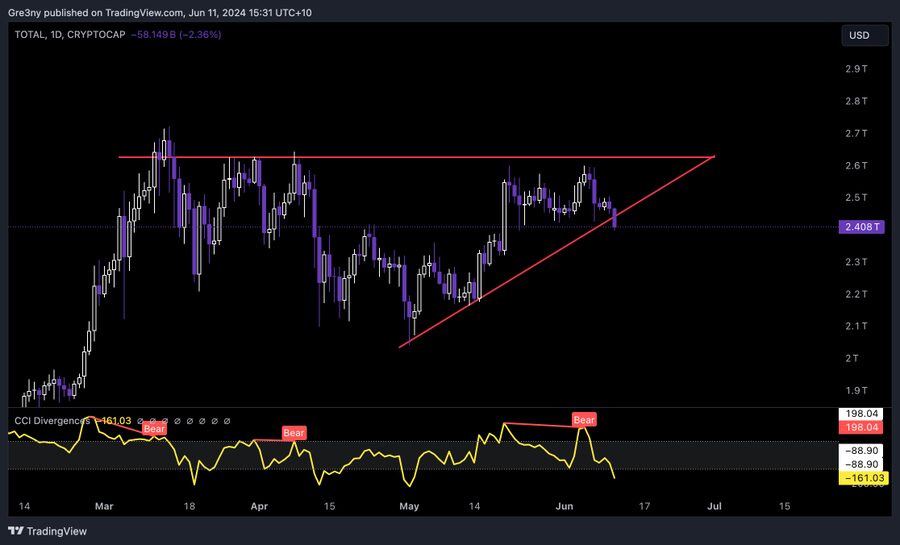
I think there are several factors that might be contributing to this downward trend. The pause in ETF accumulation has been mentioned as a potential cause, and there’s also speculation about the impact of the European Parliament election results, One of the primary reasons for today’s crypto market downfall appears to be the recent election results of the European Parliament. This political event has had a significant impact on market sentiment, causing uncertainty among investors. Additionally, the upcoming release of the US Consumer Price Index (CPI) and Producer Price Index (PPI) reports is also affecting the sentiments of global crypto investors, leading to further apprehension.
You know, it’s not the first time we’ve seen political events causing jitters in the crypto space. Back in 2016, the unexpected outcome of the Brexit referendum sent shockwaves through financial markets, including cryptocurrencies. Bitcoin, which was still in its early stages, experienced a sharp drop followed by a period of volatility. It just goes to show how interconnected the world is and how seemingly unrelated events can have ripple effects across various asset classes.
Another instance that comes to mind is the 2020 U.S. presidential election. In the lead-up to the election, the crypto market was buzzing with speculation about how the outcome might impact the industry. Some argued that a Biden win would lead to more regulation and potentially stifle innovation, while others believed that a Trump victory would create a more business-friendly environment. Ultimately, the market reacted positively to Biden’s win, with Bitcoin and other cryptocurrencies experiencing a significant surge in the following weeks. It’s a reminder that political events can cut both ways and that the crypto market is becoming increasingly sensitive to the broader geopolitical landscape.
Of course, it’s not just elections that can move the market. In 2017, the Chinese government’s crackdown on cryptocurrency exchanges and initial coin offerings (ICOs) sent the market into a tailspin. The news sparked a massive sell-off, with Bitcoin losing around 30% of its value in a matter of days. It was a stark reminder of how vulnerable the market can be to regulatory changes and how quickly sentiment can shift.
Waking up to a new day, many investors wished they hadn’t looked at the markets. The fall continues, and the state of altcoins is deplorable. Despite these challenges, there’s a strong belief that they will eventually return to their previous highs. However, the current declines are frustrating for investors who were hoping for an immediate recovery.
Do you know in June 2021, when the US CPI report indicated a sharp increase in consumer prices. This news led to widespread fears of inflation, prompting investors to move their money into safer assets. The crypto market experienced a sharp downturn, with Bitcoin falling by nearly 30% in a matter of days. Similar trends were observed in other major economies, where rising inflation led to market corrections and heightened volatility.
With the cryptocurrency market experiencing unprecedented growth over the past few months, I think volatility is normal and part of the process to grab liquidity. The looming market crash has undoubtedly raised concerns among investors, but it’s important to remember that these fluctuations are a natural part of the market cycle.
This isn’t necessarily the start of a bear market or an indication that a sudden crash is imminent. We’ve seen similar patterns before where temporary downturns were followed by strong recoveries. Big money and institutions still hold large amounts of Bitcoin and other major cryptocurrencies, and they’re unlikely to allow significant losses. It’s more of a temporary phase, similar to previous market reactions during geopolitical tensions or economic data releases.
