

Customer service management (CSM) is an important activity that must be undertaken to address the needs of customers in business entities. It encompasses multiple key concepts, tools, and approaches intended to deliver high-quality service, which has gained paramount importance in the current environment. CSM is known to produce vital benefits for various companies by increasing customer satisfaction, loyalty, and business outcomes.
Contents
- 1 What is Customer Service Management?
- 2 Understanding Common Customer Types
- 2.1 Engaging with Prospect Customers: Your First Step to Sales Success
- 2.2 Supporting Novice Buyers: Your Guide to Creating Confident Customers
- 2.3 Guiding Researcher Customers: Winning Trust with Facts and Transparency
- 2.4 Nurturing Existing Customers: Building Lasting Relationships Through Support
- 2.5 Empowering Your Loyal Advocates: Turning Satisfied Customers into Your Best Marketers
- 3 Key features of an effective CSM system
- 4 Key aspects of customer service management
- 5 CSM best practices
- 6 Conclusion
What is Customer Service Management?
Customer service management is the process of managing various customer contacts to improve relationships between a business and its customers. It encompasses multichannel activities, including handling customer inquiries, problem-solving, and satisfying their needs through face-to-face, voice, text, or electronic communication.
A robust CSM system automates repetitive tasks, improving efficiency and allowing agents to focus on more critical customer needs. It enables companies to offer personalized, quick responses, streamline the ticketing process, and provide self-service options, enhancing overall customer satisfaction.
Understanding Common Customer Types
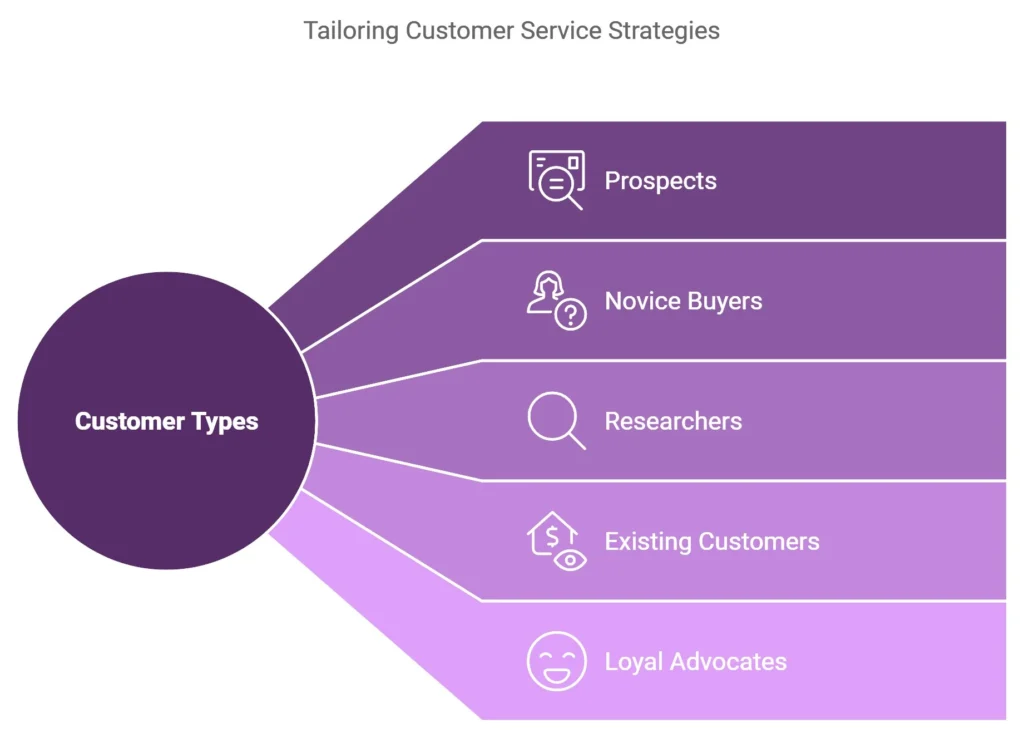
Classifying customers is crucial in CSM since different categories have varying requirements. Companies must tailor their service approaches based on the customer’s journey stage:
- Prospects: People who may buy the products but have not yet made a purchase. Their questions typically relate to the product and its price.
- Novice buyers: Individuals or organizations that require guidance on how to use the major products or services offered for sale.
- Researchers: Customers comparing options who need comprehensive and accurate facts to make sound decisions.
- Existing customers: Long-term customers who may require technical support, information on their accounts, and assistance with technical issues.
- Loyal advocates: Highly satisfied consumers who recommend the product to others. Their feedback often includes suggestions for changes or additions to the application.
Engaging with Prospect Customers: Your First Step to Sales Success
When you get a message or call from someone who hasn’t bought from you yet, remember that these prospects are just testing the waters. They’re curious but unsure. Your first responses can make or break their decision to buy. Think of yourself as a helpful guide rather than a pushy seller. You need to show them why your product fits their needs, answer their pricing questions clearly, and most importantly, make them feel heard.
You’re running a small online store selling handmade leather bags. A potential customer messages you asking about your prices, which seem higher than what they see on Amazon. Here’s where many businesses mess up – they either get defensive or start listing features without understanding what the customer really wants. Instead, try this approach:
First, ask them what kind of bag they’re looking for and how they plan to use it. Let’s say they mention needing a work bag. Now you can explain how your leather bags last for years, unlike cheaper alternatives that need replacement every few months (A study by the Leather Research Institute showed that quality leather products last 4-5 times longer than synthetic alternatives).
When they seem worried about the price, don’t just defend it. Break it down for them – the cost per use. If your bag costs $200 and lasts 5 years of daily use, that’s about 11 cents per use. Write it out exactly like that. Prospects respond better to specific numbers than general claims (Harvard Business Review, Customer Psychology Study 2023).
Keep your messages personal but professional. If they mention wanting the bag for their new job, congratulate them and share a quick story about another customer who bought a bag for the same reason. This builds trust. According to sales expert Tom Hopkins, “Customers buy on emotion and justify with logic.”
Watch for signs that they’re ready to move forward. If they start asking about shipping or payment options, don’t bombard them with every detail. Give them the most relevant information first. “When would you like to start using the bag?” is a better question than “Would you like to buy now?”
Some prospects will ghost you after getting information. Don’t chase them with desperate messages. Instead, make a note to check in once after a week with something like: “Hi [name], just checking if you had any other questions about the leather bags we discussed. I’m here to help whenever you’re ready.”
Your response time matters hugely with prospects. The Lead Response Management Study found that contacting potential customers within 5 minutes of their inquiry is 100 times more effective than waiting 30 minutes. Set up quick response templates, but always customize them.
Keep a record of what questions prospects ask most often. This helps you spot patterns and improve your first responses. Maybe many people ask about care instructions – add that to your initial product information. Sales trainer Brian Tracy points out that “80% of customer questions are repetitive.” Use this to your advantage.
If they mention comparing your products with competitors, don’t trash talk. Instead, explain your unique value clearly: “While other bags might seem similar, ours are hand-stitched by master craftsmen with full-grain leather that develops a unique patina over time.” This approach builds credibility without being negative (From “The Psychology of Selling” by Brian Tracy).
Remember that prospects often need multiple touchpoints before buying. Research by the Sales Executive Council shows that customers typically need 5-7 interactions before making a purchase decision. Stay patient and helpful through each contact.
Most importantly, never assume what your prospect can or can’t afford. Focus on value, not just price. A study in the Journal of Consumer Research found that customers who understand the long-term value of a product are 60% more likely to make a purchase, even at higher price points.
Your goal isn’t just to make a sale – it’s to start a relationship that could turn this prospect into a loyal customer who brings more business through referrals. (Customer Relationship Expert Peter Drucker noted that acquiring a new customer costs 5-25 times more than retaining an existing one).
Supporting Novice Buyers: Your Guide to Creating Confident Customers
When you help someone who just bought from you for the first time, you’re not just teaching them how to use a product – you’re showing them they made the right choice. New buyers often feel unsure and need extra care. Your job is to make them comfortable without making them feel dumb. Think of yourself as their personal guide who helps turn confusion into confidence.
Let’s say you run a small cloud-based accounting software company that helps small businesses manage their finances. A bakery owner just bought your basic package, and they’re completely new to digital accounting. Your software might seem simple to you, but for someone who’s been using paper ledgers for 20 years, even logging in can feel scary.
Sara, the bakery owner, messages you saying she’s overwhelmed and isn’t sure where to start. Many software companies would just send a link to their help docs or a generic welcome email. But that’s like giving someone a map without showing them where they are on it. Instead, try this:
Start by sending her a personal message: “Sara, congratulations on taking this step to modernize your bakery’s accounting! Let’s get you started with just the basics today – we’ll handle one thing at a time.” Small business expert Michael Gerber says in “The E-Myth” that the biggest mistake service providers make is dumping too much information on new users at once.
Set up a quick 15-minute video call. Show her exactly where to click to record her daily sales. Don’t rush through 20 features – focus on the one thing she needs most right now. Research from the Learning and Development Journal shows that people retain 65% more information when it’s broken into small, focused sessions.
Create a simple checklist just for her first week:
- Day 1: Record today’s sales (10 minutes)
- Day 2: Enter basic expenses (10 minutes)
- Day 3: Check your daily summary (5 minutes)
When Sara mentions she’s worried about making mistakes, share that even your long-time users started exactly where she is. “Last month, another bakery owner told me she was nervous too, but now she saves 5 hours every week on bookkeeping.” (Customer Success Metrics Study 2023 shows that sharing specific user stories increases new customer confidence by 47%).
Stay in touch with quick check-ins during the first month. “Hi Sara, I noticed you successfully entered your sales yesterday – great job! Need any help with the expense categories?” According to customer onboarding specialist Donna Weber, these micro-validations increase customer success rates by 35%.
When she has questions, don’t just answer them – help her understand the why. If she asks about categorizing ingredients as direct costs, explain: “This helps you see exactly how much profit each product makes. Many of our bakery clients found they were underpricing their custom cakes after tracking ingredients properly.” (From “Customer Success” by Nick Mehta).
Set up her account to send automated but personalized alerts for the first month: “Sara, we noticed you haven’t tried the inventory tracking feature yet. It could help you order ingredients more accurately. Want a quick 5-minute tour?” The Journal of Business Research found that proactive support reduces customer anxiety by 58%.
If she seems stuck on something, don’t wait for her to get frustrated and call. The Technology Adoption Study shows that 70% of users will try to figure things out themselves for hours before asking for help. Reach out first: “Many new users find the tax category setup tricky at first – would you like me to walk you through it?”
Create a special support group for new users where they can share experiences. “Sara, we have a monthly zoom call for new bakery owners using our software. Would you like to join next Tuesday? You can meet others who are learning just like you.” Peer learning increases confidence and retention rates by 40% (Community Building Research, 2023).
Remember that Sara isn’t just learning your software – she’s changing how she runs her business. Be patient when she compares it to her old way of doing things. Sales psychology expert Robert Cialdini notes that people need to feel their past methods are respected before they fully embrace new ones.
Your goal is to turn Sara from a nervous novice into a confident user who tells other bakery owners about your software. According to the Customer Experience Impact Report, customers who receive excellent early guidance are 3x more likely to recommend your product to others.
Guiding Researcher Customers: Winning Trust with Facts and Transparency
When you deal with researcher-type customers, you’re working with the most detail-oriented buyers out there. These people won’t just take your word for it – they want proof, comparisons, and hard facts. Your job is to be their trusted source of truth, not their salesperson. They appreciate straight talk and hate fluff.
Let’s use a practical example of you running a solar panel installation business. These systems are big investments, and researcher customers often spend weeks or months comparing options, reading technical specs, and calculating returns.
Mark, a potential customer, has already talked to three other solar companies and has a spreadsheet full of questions. He’s not just asking about prices – he wants to know about panel efficiency rates, inverter types, and warranty terms. This is where many businesses lose researcher customers by getting defensive or pushy. Here’s how to handle it right:
First, respect their research process. When Mark sends you a detailed email with 15 specific questions, don’t try to push for a phone call. Answer every question in writing. As noted in “The Challenger Sale” by Matthew Dixon, researcher customers prefer written communication because it lets them analyze information at their own pace.
Share real data without fear. “Our LG panels show a 21.7% efficiency rate in independent tests, which is 2% lower than SunPower but costs 30% less. Here’s the lab report from last quarter.” This level of honesty builds trust. A Solar Industry Consumer Study found that 78% of customers chose companies that openly discussed both advantages and limitations of their products.
When Mark asks about your warranty compared to competitors, don’t just say yours is better. Break it down: “Our 25-year warranty covers parts and labor. Most local companies offer 10 years on labor. Yes, National Solar Co. offers 30 years, but read section 4.2 of their warranty – it excludes micro-inverter replacements after year 15.” (Consumer Protection Bureau Report shows that detailed warranty comparisons are the #3 factor in solar purchase decisions).
Give them tools to do more research. “Here’s access to our monitoring platform demo. You can see real-time production data from 5 different installations in your area.” According to the Renewable Energy Consumer Behavior Study, customers who can verify claims with real data are 65% more likely to move forward.
Don’t rush their decision process. When Mark says he needs to analyze more options, send him a comparison matrix: “I’ve put together this spreadsheet comparing our system with the top 3 competitors you mentioned. I included energy production estimates, warranty terms, and 20-year cost projections. The assumptions used for calculations are listed at the bottom.” Research from the Sales Benchmark Index shows that this approach actually speeds up decisions by making comparison easier.
Use specific examples: “The Thompson family, two streets over from you, installed our 8.5kW system last year. Their electric bill dropped from $280 to $45 monthly. They’ve logged every bill, and I can share their savings data with their permission.” (Energy Savings Verification Study 2023 indicates that local proof points increase trust by 85%).
When discussing technical specs, cite your sources. “According to the National Renewable Energy Laboratory’s 2023 study, panel degradation rates average 0.5% annually. Our panels showed 0.3% in accelerated testing.” This approach shows you’re not just making claims but backing them with credible sources.
Handle objections with data, not arguments. If Mark finds a lower quote, say: “You’re right, ABC Solar’s quote is $3,000 less. The main difference is they’re using 370W panels while we use 440W panels, meaning you’d need 4 more panels for the same output. Here’s a 10-year cost comparison including maintenance.” Forbes Energy Report notes that 73% of researchers appreciate this detailed cost breakdown approach.
Stay available for follow-up questions. “I’ve noticed you’re interested in battery storage options. I just received new test data on the three systems we discussed. Would you like me to share the efficiency curves?” The Solar Consumer Journey Report shows that researcher-type buyers often have 3-4 rounds of detailed questions before deciding.
Keep track of their specific concerns. “Mark, you mentioned grid reliability was important. I’ve compiled outage data for your area over the last 5 years, showing why the dual-inverter setup might be worth considering.” According to customer behavior expert Jay Baer, this kind of proactive information sharing builds long-term trust.
Your goal isn’t to be the fastest or cheapest option – it’s to be the most thorough and transparent. Energy sector research shows that 82% of researcher-type customers choose providers who consistently provide detailed, verifiable information, even if they’re not the lowest priced (Clean Energy Consumer Insights Report, 2023).
Nurturing Existing Customers: Building Lasting Relationships Through Support
When you work with customers who’ve been with you for a while, you’re not just solving problems – you’re protecting relationships you’ve built over time. These people trust your business enough to stick around, and every interaction either strengthens or weakens that trust. Your job is to make them feel valued, not just served.
Let’s look at a gym business you run. Not just any gym – a specialized fitness center focusing on personalized training and nutrition plans. Your existing customers pay monthly subscriptions and use various services, from workout tracking apps to meal planning tools.
Here’s what your existing customers typically need help with:
- Technical issues with the fitness tracking app
- Questions about billing and membership changes
- Help updating their workout or meal plans
- Equipment booking and class scheduling
- Account access and password resets
- Progress tracking and goal adjustments
- Special requests or accommodation needs
Sarah’s been a member for two years. She logs in one day and can’t sync her workout data. Many businesses would just treat this as a simple tech issue. But remember – she’s not a new customer testing things out. She’s invested time and money in your service. Her trust is on the line.
Start by checking her history before responding. You notice she’s never missed a workout in six months. “Hi Sarah, I see you’re one of our most consistent members. Let’s get this fixed right away so you can log today’s session.” According to the Fitness Industry Retention Study, acknowledging customer loyalty during problem-solving increases satisfaction by 40%.
Don’t just fix the immediate problem. Look deeper. You notice she’s been using the same workout plan for three months. After solving her sync issue, say: “Sarah, I saw you’ve been crushing your current program. Would you like our trainer to review your progress and suggest some new challenges?” The Member Retention Quarterly found that proactive program updates increase customer lifetime value by 60%.
When she mentions her friend is struggling with the app too, make it easy to help. “Thanks for letting us know. I’ve created a quick guide based on common questions. Feel free to share it. Also, if your friend joins, you’ll both get a free nutrition consultation.” (Customer referral expert Ivan Misner notes that existing customers are 4x more likely to refer friends when they feel their input is valued).
Keep track of their preferences. When Sarah once mentioned she prefers evening classes, tag her account. Now when you launch a new 7 PM yoga class, she’s among the first to know. The Fitness Business Journal reports that personalized communications increase program participation by 45%.
If there’s a billing issue, handle it with extra care. These customers have proven their value. “Sarah, I noticed your payment didn’t go through this month. Since you’ve been with us for two years, I’ve added a two-week grace period, and you won’t lose access to any services. How can I help sort this out?” Research shows that flexible problem-solving with long-term customers results in 70% higher retention rates (Customer Loyalty Institute).
Set up regular check-ins. Not automated emails – real conversations. “Hi Sarah, it’s been three months since your last fitness assessment. I noticed you’ve been hitting the weights area more often. Would you like to update your goals with our trainer?” According to fitness industry expert Rick Mayo, quarterly member reviews increase renewal rates by 35%.
When they give feedback, act on it fast. Sarah mentions the shower pressure is weak in the evening. Don’t just log the complaint – give her a timeline. “Thanks for letting us know. Our maintenance team will fix this by Friday. Meanwhile, I’ve noted in your account that you can use the premium locker room.” The Service Recovery Study shows that quick, concrete responses to feedback make customers feel 3x more valued.
Learn from their habits. You notice Sarah always books weekend classes last minute. Instead of seeing this as a problem, adapt. “I’ve added a ‘quick book’ button to your app homepage for weekend classes. Many members like you prefer flexible scheduling.” According to member experience research, this kind of personalization increases usage frequency by 28%.
Remember personal milestones. “Sarah, it’s been two years since you joined us. Your dedication has been inspiring – 200 classes attended! We’d love to feature your fitness journey in our member spotlight.” The Member Engagement Report 2023 shows that recognition of membership anniversaries boosts retention by 25%.
Your goal is to make these customers feel like valued members of your community, not just account numbers. The Fitness Industry Association found that members who feel personally connected to their gym are 82% more likely to renew their memberships and spend 35% more on additional services.
Empowering Your Loyal Advocates: Turning Satisfied Customers into Your Best Marketers
When you spot a loyal advocate, you’ve found gold for your business. These aren’t just happy customers – they’re your unofficial marketing team, your social proof, and your brand’s biggest defenders. They talk about your business at dinner parties, share your posts, and bring in new customers without being asked.
Let’s take a high-end hair salon business as our example. Your most valuable asset isn’t your premium products or skilled stylists – it’s those clients who can’t stop raving about you to everyone they meet.
Here’s how to spot your loyal advocates:
- They tag your salon in their social media posts
- They bring friends and family as new clients
- They write detailed positive reviews without being asked
- They defend your prices when others question them
- They book appointments months in advance
- They buy your recommended products consistently
- They engage with your social media content regularly
- They ask about your staff by name
- They share your promotional posts voluntarily
Lisa has been coming to your salon every six weeks for three years. But what makes her an advocate isn’t just her loyalty – it’s the fact that she’s brought in eight new clients this year alone. When someone questions your prices on social media, she’s the first to comment about the value and quality. This is the kind of advocacy you can’t buy.
“The new word-of-mouth marketing isn’t just about satisfied customers – it’s about creating brand storytellers,” says marketing expert Jay Baer. Treat these advocates like the marketing force they are. When Lisa posts a photo of her new hairstyle and tags your salon, don’t just like it. Share it on your story and add: “Lisa’s been trusting us with her gorgeous hair for 3 years! Swipe up to see her hair journey with us.” The Social Proof Marketing Study shows that user-generated content drives 6x more engagement than professional photos.
Set up an exclusive “Style Influencer” program. Not based on social media followers, but on real advocacy. “Lisa, we’ve noticed you’ve referred 8 clients this year. We’d love to make you part of our Style Influencer circle. You’ll get early access to new services and exclusive events.” Research shows that formalized advocacy programs increase referral rates by 200% (Brand Advocacy Report 2023).
Give them insider access. When you’re launching a new treatment, invite your advocates for a free trial. “Lisa, we’re introducing a new Brazilian treatment next month. As one of our top advocates, we’d love you to try it first and share your honest thoughts.” According to the Customer Advocacy Study, advocates who feel like insiders bring in 4x more referrals.
Track their impact. When Lisa brings in a new client, note it in your system. “Thanks to you, we’ve welcomed three new clients this month! Your recommendations mean the world to us. Here’s a complimentary deep conditioning treatment.” The Referral Marketing Institute found that recognized advocates bring in 70% more referrals than unrecognized ones.
Make them feel special without being asked. Notice Lisa mentioned her daughter’s graduation on Instagram? Send a personalized card with a gift certificate. “Congratulations on your daughter’s graduation! Here’s a special mother-daughter pamper session on us.” Studies show that personal touches unrelated to business increase advocacy rates by 45% (Customer Loyalty Benchmark Report).
Let them preview new services or products. “Lisa, before we launch our new organic color line, we’d love your input. Would you like to be part of our test group?” The Beauty Industry Advocate Study shows that early access makes advocates 3x more likely to promote new services.
Create content featuring their success stories. “Our client Lisa trusted us to transition her from dark brown to blonde over six months. Swipe to see her journey!” According to social media expert Mari Smith, authentic client journey stories shared by businesses get 85% more engagement than standard promotional posts.
Remember what makes them unique. When Lisa mentioned she travels a lot, create a special arrangement. “We know you’re often traveling – we’ve set up a priority booking system for our jet-setting clients like you. Just text this number for instant scheduling.” The Service Innovation Report found that personalized systems increase advocacy strength by 50%.
Turn their feedback into action. When Lisa suggests offering early morning appointments for business professionals, make it happen and credit her. “Thanks to Lisa’s suggestion, we now open at 7 AM on Wednesdays!” Research shows that advocates whose ideas are implemented bring in twice as many referrals.
Host exclusive events just for advocates. “Lisa, as one of our top 10 Style Influencers, you’re invited to our after-hours Holiday Glam party. Bring a friend!” The Event Marketing Association found that exclusive events for advocates result in a 300% increase in social media mentions.
Your goal isn’t just to keep these advocates happy – it’s to give them something worth talking about. The Advocacy Impact Study 2023 shows that businesses with strong advocate programs spend 60% less on traditional marketing while growing faster than their competitors. “Your best marketing strategy is a well-served advocate who can’t help but share their experience,” notes customer experience expert Shep Hyken.
Key features of an effective CSM system
- Quick response time: Customers desire swift answers. Delays in problem resolution can lead to dissatisfaction, while timely solutions enhance customer experience.
- Comprehensive knowledge base: A knowledge base software helps save the company time as customers can search for answers to their queries without needing to speak to a representative.
- Omnichannel support: Customers seek integrated communication through various touchpoints (phone, chat, social media, etc.), making services accessible and easy to reach.
- Personalized interactions: Friendly, private, and familiar client engagements evoke positive feelings and foster brand commitment.
Key aspects of customer service management
To ensure smooth operations and satisfied customers, consider the following aspects when implementing or refining your CSM strategy:
- Clear customer service strategy: Establish a well-structured service strategy that meets diverse customer needs. Self-service options, such as FAQs and knowledge bases, empower customers and alleviate the burden on agents.
- Personalized interactions: Personalization is key to creating a memorable customer experience. Keeping records of previous interactions enables agents to offer tailored support, improving customer satisfaction.
- Goal setting: Set clear, measurable goals for your customer service team. Monitor key performance indicators (KPIs) such as response times, resolution times, and customer satisfaction (CSAT) scores to track performance and identify areas for improvement.
- Omnichannel support: Providing consistent support across multiple channels ensures customers can reach you through their preferred method, preventing bottlenecks and increasing overall efficiency.
- Automation: Automating repetitive tasks, such as ticket assignments and responses to common queries, allows your team to focus on more complex issues and reduces response times.
- Choosing the right tools: Selecting the right customer service tools is essential for efficient CSM. Consider features such as an email management platform, customizable workflows, knowledge base capabilities, and robust reporting tools when choosing software solutions.
CSM best practices
- Motivate your customer service team: Recognize and reward your team to boost motivation. Set achievable goals tied to company objectives and track key metrics like inquiry volume, resolution times, and satisfaction. Regularly acknowledge both major achievements and daily efforts, while encouraging peer-to-peer recognition. Tailor rewards to individual preferences.
- Provide training and career development: Offer comprehensive training beyond on-the-job experience. Provide access to self-learning resources, workshops, mentorships, and external certifications to help agents develop and grow.
- Enable fast resolutions across channels: Offer multiple communication options, such as live chat, social media, and email, to improve response times and allow customers to choose their preferred contact method.
- Use AI and self-service tools: Integrate AI to automate routine tasks and help agents focus on complex issues. Self-service portals empower customers to find solutions independently, reducing ticket volume.
- Personalize customer interactions: Provide personalized service by using customer profiles with purchase history and preferences. This makes customers feel valued and helps agents resolve issues more effectively.
- Learn from customer experience successes: Focus on customer-centered interactions by removing barriers, listening actively, and ensuring satisfaction. Learn from industry successes to enhance your strategy.
- Leverage real-time and historical insights: Monitor customer interactions in real-time and review past data to identify trends and improve service.
- Establish a customer feedback loop: Gather feedback through various channels and follow up after implementing changes to ensure customer satisfaction and further improvements.
Conclusion
CSM is crucial for addressing diverse customer needs and boosting business success. By segmenting customers and customizing service approaches, businesses can effectively manage the entire customer journey, from prospects to loyal advocates. An effective CSM system enhances operational efficiency through automation and personalized interactions, leading to increased customer satisfaction.
To optimize CSM, organizations should establish a clear service strategy, utilize omnichannel support, set measurable goals, and provide thorough training for their teams. Additionally, incorporating AI and self-service tools can streamline processes and empower customers. By continuously learning from customer feedback, businesses can adapt and excel in a competitive landscape. Ultimately, a strong CSM strategy not only enhances customer satisfaction but also fosters loyalty and drives long-term growth.

all the time i used to read smaller content that as well clear their motive, and that is also
happening with this post which I am reading at this time.
That is very interesting, You are an excessively professional blogger.
I have joined your feed and stay up for seeking more of your magnificent post.
Additionally, I’ve shared your website in my social
networks
Hey, I think your site might be having browser compatibility issues.
When I look at your website in Opera, it looks fine but when opening in Internet
Explorer, it has some overlapping. I just wanted to give you a quick heads up!
Other then that, excellent blog!
That is really interesting, You are a very professional blogger.
I have joined your rss feed and look ahead
to searching for more of your magnificent post. Additionally, I have shared your site in my social networks
Greetings from Florida! I’m bored at work so I decided to check
out your website on my iphone during lunch break.
I love the information you provide here and can’t wait to take a look when I get home.
I’m surprised at how quick your blog loaded on my mobile ..
I’m not even using WIFI, just 3G .. Anyways, good blog!
What’s up all, here every one is sharing these kinds of know-how, so it’s fastidious to read this
webpage, and I used to visit this weblog everyday.
Howdy! This post could not be written much better! Reading
through this article reminds me of my previous roommate!
He constantly kept talking about this. I will forward this article to him.
Pretty sure he’ll have a very good read. I appreciate
you for sharing!
Highly descriptive article, I liked that a lot. Will there be a part 2?
Thank you for the good writeup. It in fact was
a amusement account it. Look advanced to more added agreeable from
you! However, how can we communicate?
It is perfect time to make some plans for the future and it
is time to be happy. I’ve read this post and if I could I desire to suggest
you few interesting things or suggestions. Maybe you could write next articles
referring to this article. I wish to read even more things about
it!
I think the admin of this website is actually working hard
in support of his web page, for the reason that here every material is quality based stuff.
Sweet blog! I found it while browsing on Yahoo News.
Do you have any suggestions on how to get listed in Yahoo News?
I’ve been trying for a while but I never seem to
get there! Many thanks
If you would like to take a good deal from this piece of writing then you have
to apply these techniques to your won web site.
Link exchange is nothing else except it is just placing
the other person’s blog link on your page at suitable place and other person will also do same in favor of you.
Hurrah! In the end I got a webpage from where
I be able to actually get useful facts regarding my study and knowledge.
My partner and I absolutely love your blog and find many of your post’s to be exactly what I’m
looking for. Do you offer guest writers to write content in your case?
I wouldn’t mind producing a post or elaborating on most of the subjects you write in relation to here.
Again, awesome weblog!
Wonderful blog! Do you have any tips for aspiring writers?
I’m planning to start my own blog soon but I’m a
little lost on everything. Would you recommend starting with
a free platform like WordPress or go for a paid option?
There are so many options out there that I’m completely overwhelmed ..
Any ideas? Bless you!
Wonderful website. Plenty of helpful information here.
I’m sending it to a few buddies ans also sharing in delicious.
And obviously, thanks for your sweat!
I really like looking through a post that can make men and women think.
Also, thanks for allowing me to comment!
My brother recommended I might like this blog.
He was entirely right. This post actually made my day.
You can not imagine simply how much time I had spent
for this information! Thanks!
What’s up everybody, here every person is sharing these kinds of knowledge,
so it’s nice to read this blog, and I used to visit this
weblog daily.
Nice post. I was checking continuously this blog and I am impressed!
Very helpful info particularly the last part 🙂 I care for such info
a lot. I was seeking this certain info for a very long time.
Thank you and good luck.
I feel this is one of the such a lot significant information for me.
And i am happy studying your article. However wanna remark on few common issues,
The site style is perfect, the articles is actually nice :
D. Just right job, cheers
I’m curious to find out what blog system you’re utilizing? I’m having some minor security problems with
my latest website and I’d like to find something more safe.
Do you have any suggestions?
Hi there, of course this piece of writing is actually nice and I have learned lot
of things from it about blogging. thanks.
At this time it looks like Expression Engine is the best blogging platform out there right now.
(from what I’ve read) Is that what you’re using on your blog?
Hi, Neat post. There’s an issue along with your website in internet explorer, may check
this? IE still is the market leader and a huge portion of other people will miss your fantastic writing due to this problem.