

When people first learn about blockchain technology and Bitcoin, they often get confused by terms like UTXO. Think of UTXO (Unspent Transaction Output) as digital change from a transaction. Just like when you buy something at a store with cash and receive change back, blockchain transactions work in a similar way. Every time someone makes a transaction, the system creates these “pieces of change” that can be used in future transactions. This system is crucial because it helps keep track of every bit of cryptocurrency, ensuring that no one can spend the same money twice.
The blockchain system that manages these transactions is like a giant, shared record book that everyone can see but no one can change without everyone else agreeing. It works through a network where all participants (called nodes) work together to verify and record every transaction. This system is completely digital and doesn’t rely on any central authority like a bank to manage it. Instead, it uses complex mathematical rules and cooperation between users to keep everything secure and accurate.
To know more about bitcoin trading you can visit to check is reasonable have digital wallet.
Contents
What is a UTXO?
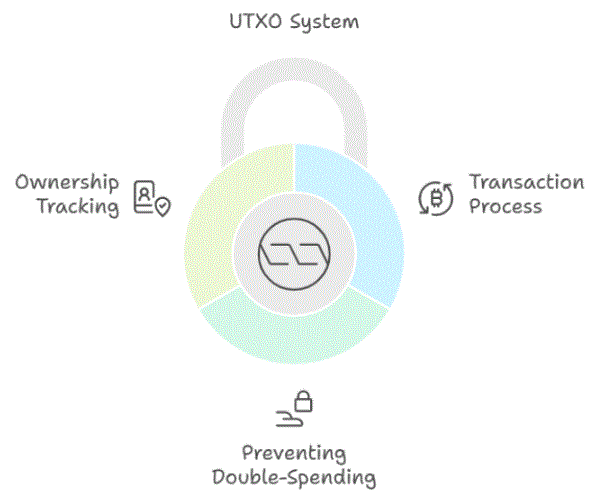
A UTXO is essentially leftover cryptocurrency from a transaction that can be used in future transactions. Imagine you have 1 Bitcoin and want to send 0.7 Bitcoin to someone. The system will create two pieces: one piece of 0.7 Bitcoin that goes to the recipient and another piece (the UTXO) of 0.3 Bitcoin that comes back to you. This UTXO of 0.3 Bitcoin is now available for you to use in your next transaction.
This system is particularly important in Bitcoin and many other cryptocurrencies because it helps prevent double-spending and makes it easier to track the ownership of digital assets. Every time you make a transaction, you’re actually using UTXOs from your previous transactions as inputs. The system then creates new UTXOs as outputs, which can be used in future transactions. This creates a clear chain of ownership that can be verified by anyone on the network.
How UTXOs Work in Practice

Let’s look at how UTXOs work in everyday cryptocurrency transactions. Imagine you have a digital wallet with three separate UTXOs:
- UTXO 1: 0.5 BTC
- UTXO 2: 0.3 BTC
- UTXO 3: 0.2 BTC
If you want to send someone 0.7 BTC, your wallet needs to combine UTXOs to make this transaction happen. It might use UTXO 1 (0.5 BTC) and UTXO 2 (0.3 BTC), which totals 0.8 BTC. Since you only want to send 0.7 BTC, the transaction will create two new UTXOs:
- A UTXO of 0.7 BTC sent to the recipient
- A change UTXO of 0.1 BTC returned to your wallet
After this transaction, your wallet would have two UTXOs:
- The new change UTXO of 0.1 BTC
- The unused UTXO 3 of 0.2 BTC
About Unspent Transaction Output (UTXO)
The UTXO system works like a sophisticated digital wallet that keeps track of all your cryptocurrency pieces. Each UTXO is unique and can only be used once. When you receive cryptocurrency, you’re actually receiving UTXOs that are locked to your address. These UTXOs remain in your wallet until you decide to spend them in a new transaction.
Understanding UTXOs is crucial for anyone using cryptocurrencies because they affect how transactions work and how you manage your digital assets. For example, if you need to send someone a specific amount of cryptocurrency, your wallet software will automatically select the appropriate UTXOs to use as inputs for that transaction. If the UTXOs add up to more than you need to send, the system will create a new UTXO with the difference and return it to your wallet as change.
UTXO Model Goal
The primary goal of the UTXO model is to create a transparent and secure way to track cryptocurrency ownership. While cryptocurrencies offer privacy through anonymous addresses, the UTXO system ensures that all transactions are visible and verifiable on the public blockchain. This creates an interesting balance between privacy and transparency.
The system works by linking UTXOs to public addresses, which are like digital mailboxes where you can receive cryptocurrency. While anyone can see these addresses and the transactions associated with them, they can’t automatically know who owns the address unless the owner reveals this information. This system helps prevent fraud while still maintaining user privacy, making it an essential part of how cryptocurrencies work.
| Goal | Description | Benefits | Real-World Example |
|---|---|---|---|
| Transaction Transparency | All transactions are visible on public blockchain | – Prevents double spending – Creates audit trail – Enables verification by anyone | Like being able to see a check was written, but not seeing the account holder’s personal details |
| Privacy Protection | Uses anonymous public addresses | – Maintains user anonymity – Protects financial privacy – Reduces identity theft risk | Similar to having a P.O. box instead of sharing your home address |
| Fraud Prevention | Each UTXO can only be spent once | – Eliminates double spending – Creates clear ownership trail – Makes fraud attempts visible | Like having serial numbers on paper money to prevent counterfeiting |
| Ownership Tracking | Links funds to specific addresses | – Clear proof of ownership – Easy to verify holdings – Simplifies disputes | Similar to having a deed for your house that proves ownership |
| System Security | Cryptographic protection of transactions | – Tamper-proof records – Secure transfers – Immutable history | Like having a bank vault with multiple security layers |
| Decentralized Control | No central authority needed | – Peer-to-peer transactions – No intermediary fees – 24/7 operation | Similar to cash transactions between individuals |
| Balance Verification | Easy to check available funds | – Prevents overdrafts – Real-time balance updates – Accurate spending limits | Like having an up-to-date bank statement |
| Transaction Building | Combines UTXOs for payments | – Flexible spending amounts – Efficient fund management – Automatic change creation | Similar to combining different bills to make exact payment |
| Network Scalability | Parallel processing of transactions | – Faster verification – Better network performance – Reduced bottlenecks | Like having multiple checkout lanes in a store |
| Historical Recording | Maintains complete transaction history | – Perfect for auditing – Helps resolve disputes – Enables analysis | Similar to keeping all receipts for tax purposes |
Cryptographically Linked Together
- Specialised for the first block (sometimes referred to as the genesis block), every block in the blockchain has a field called a prior hash. This is a chain whose hashes of previous blocks exist. Blockchain is incredibly safe because of this.
- Alternatively, the attacker must mine each block from that moment forth. In a 51% attack, this is a potential outcome.
Various Structures Present in the Transaction
A single transaction can be broken down into numerous discontiguous structures, each of which has a unique semantic meaning. The various structures that are part of the transaction include the following:
Transaction Version Number
The transaction version number works like a set of instructions for the blockchain network. Think of it as a language version that tells the network computers (nodes) exactly how to handle and process the transaction. For example, version 1 might handle basic transfers, while version 2 could include additional features like time locks or multiple signatures. When a transaction is created, this version number helps ensure that all nodes in the network understand and process it correctly. Without this version number, different nodes might interpret the transaction differently, leading to confusion and potential errors in the blockchain. It’s similar to how different versions of software need to be compatible to work together properly.
Lock Time
Lock Time is a powerful feature that acts like a timer for transactions. Just as you might write a check with a future date, Lock Time lets you create transactions that won’t be processed until a specific time or block height is reached. This waiting period can be set for hours, days or even months in the future. For example, you might want to set up a recurring payment that only processes on the first of each month or create a transaction that won’t be valid until certain conditions are met. This feature is particularly useful for setting up automated payments, creating time-sensitive contracts or ensuring funds aren’t released until a specific milestone is reached.
Transaction Input Structure
The transaction input system works like a digital key and lock combination. Each input consists of two main parts: the unlocking key (like your house key) and a pointer (like the address of your house). The pointer shows which previous transaction output you’re trying to spend, while the unlocking key proves you have the right to spend it. When you make a transaction, the system checks if your key matches the lock on those funds. Once the transaction is confirmed, the network marks those specific funds as spent, preventing them from being used again. This process creates a clear chain of ownership and prevents the same cryptocurrency from being spent multiple times, much like how a physical dollar bill can’t be in two places at once.
All outputs that have not yet been unlocked by an input are Unspent Transaction Output (UTXO). When an output is unlocked, it is taken out of the supply that is being used. They are replaced by the outputs. As a result, the values of the newly formed outputs will eternally add up to the sum of the unlocked outputs.
Common UTXO Challenges and Solutions
Challenge 1: Dust Transactions
Sometimes, very small UTXOs (called “dust”) can accumulate in your wallet. These tiny amounts might cost more in transaction fees to spend than they’re worth. Many wallets now include features to handle dust by either combining small UTXOs during quiet periods or avoiding creating very small UTXOs in the first place.
Challenge 2: UTXO Management
Having too many small UTXOs can make transactions slower and more expensive. Smart wallet software helps by:
- Combining UTXOs during low-fee periods
- Selecting the most efficient UTXO combinations for transactions
- Managing change outputs to create useful UTXO sizes
Challenge 3: Privacy Considerations
Every UTXO transaction is visible on the blockchain, which can reveal spending patterns. To maintain privacy, users can:
- Use different addresses for different transactions
- Avoid reusing addresses
- Consider using privacy-focused wallet features
Expert Reviews
“This UTXO system has revolutionized how we think about digital transactions. It’s simplicity and effectiveness make it one of blockchain’s most brilliant innovations.” – Cryptocurrency Research Director with 10 years of experience
“Understanding UTXOs is crucial for anyone serious about blockchain technology. They’re the foundation of how we maintain accuracy in digital transactions.” – Blockchain Developer of 12 years
“The UTXO model represents a perfect balance between transaction transparency and user privacy. It’s what makes cryptocurrencies both secure and usable.” – Digital Currency Expert with 8 years of experience
Technical Breakdown Table
| UTXO Component | Function | Real-World Analogy |
| Input | Previous transaction reference | Using cash from your wallet |
| Output | New transaction creation | Getting change back |
| Lock Script | Security mechanism | PIN number on a debit card |
| Public Address | Transaction destination | Bank account number |
| Verification | Transaction confirmation | Bank processing a check |
| Change Output | Leftover amount | Getting change from a purchase |
Conclusion
The UTXO model remains a cornerstone of cryptocurrency technology, offering a robust and reliable way to track and transfer digital assets. While it may seem complex at first, understanding UTXOs is crucial for anyone seriously interested in cryptocurrencies. The system continues to evolve, with new improvements and solutions being developed to address challenges and enhance functionality.
Quick Reference Guide
| Aspect | Description | Why It Matters |
| Creation | Generated from transactions | Ensures accurate value tracking |
| Usage | Can only be spent once | Prevents double-spending |
| Size | Can be any amount | Allows flexible transactions |
| Security | Cryptographically secured | Maintains system integrity |
| Privacy | Linked to public addresses | Balances transparency and privacy |
| Management | Handled by wallet software | Simplifies user experience |
By understanding these fundamentals, users can better manage their cryptocurrency transactions and make more informed decisions about their digital assets.