

There are two types of blogs – thematic blogs, where the writer focuses on a particular topic, and personal blogs, where the writer may cover many subjects. A thematic blog series is a collection of content on any niche, but focusing on a specific theme.
By focusing on a particular theme, it attracts a specific audience that is interested in the topic. The area of interest could be anything – travel, technology, photography, food, and music, among others. It could even be about how to write better content, especially on SEO-friendly blog writing services. The information provided is also detailed, as there is a series of posts that delve into various aspects of the topic. There is an in-depth analysis, information, and insights.
Contents
- 0.1 Understanding E-E-A-T
- 0.2 How Google Uses E-E-A-T
- 0.3 How to Use a Thematic Blog as an E-E-A-T Tool
- 1 Get E-E-A-T For Thematic Blog
- 1.1 How Each E-E-A-T Signal Works for GardenGrow.com
- 1.1.1 1. EXPERIENCE – Proving You’ve Actually Done This
- 1.1.2 2. EXPERTISE – Demonstrating Deep Knowledge
- 1.1.3 3. AUTHORITATIVENESS – Becoming The Source Others Quote
- 1.1.4 4. TRUSTWORTHINESS – Building Long-Term Credibility
- 1.1.5 How They Connect & Compound
- 1.1.6 Demonstrate your expertise
- 1.1.7 Build Your Authority
- 1.1.8 Build Trustworthiness
- 1.1.9 Improve User Experience
Understanding E-E-A-T
E-E-A-T refers to Experience, Expertise, Authoritativeness, and Trustworthiness. Google updated its guidelines in December 2022 for search ranking systems and included an extra E. Previously, these guidelines had the acronym E-A-T, meaning Expertise, Authoritativeness, and Trustworthiness. The extra “E” is for Experience.
- Experience – Google now looks for content that shows experience related to the topic. This means that if the user searches for information on paragliding, Google’s search engine results page will rank the pages carrying paragliding information higher.
- Expertise – Google also looks for credibility. It will give higher ranks to content that has been written by someone who has expertise on paragliding and push down copy by a writer with no knowledge on the subject. Expertise refers to a detailed and accurate review.
- Authoritativeness – This refers to the overall reputation in the industry, particularly among those who are experts in the niche. People who depend on you for information, which makes your content authoritative.
- Trustworthiness – This refers to the trustworthiness of your blog or website. It isn’t just about the content and may also include how secure your domain is, what it is doing to protect user information, and the number of positive reviews.
How Google Uses E-E-A-T

How to Use a Thematic Blog as an E-E-A-T Tool
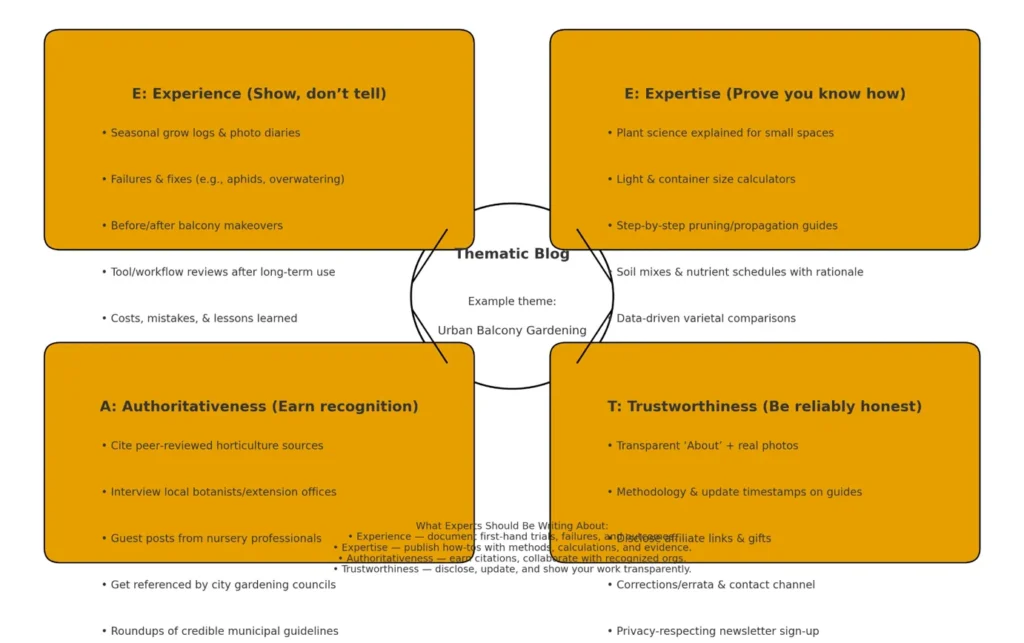
Running a thematic blog is a good way to demonstrate E-E-A-T to the search engine. This means, when you write a series of content on a specific theme, your blog will be able to establish itself as an authority, as a trustworthy source, and a go-to destination on the topic.
Get E-E-A-T For Thematic Blog
Using GardenGrow.com as Example – How Each Signal Gets Triggered
EXPERIENCE
Shows actual garden photos from 2019-2024
Documents “My tomatoes died from blight in June 2023”
Weekly garden updates with timestamps
Trigger: First-person narrative with dates
EXPERTISE
Explains NPK ratios affect on root development
Uses Latin names: “Solanum lycopersicum”
Soil pH charts with amendment calculations
Trigger: Technical depth beyond basics
TRUSTWORTHINESS
Clear affiliate disclosures at top of posts
Shows failed experiments: “Don’t try this”
Updates old posts with “2024 Note: This changed”
Trigger: Transparency & accountability
How Each E-E-A-T Signal Works for GardenGrow.com
1. EXPERIENCE – Proving You’ve Actually Done This
What triggers it: Google sees patterns that only come from real experience. Not “plant tomatoes 18 inches apart” but “I planted my Cherokee Purples 12 inches apart in 2022 and lost 80% to fungal disease. Here’s the photo from July 15.”
Content that works:
• “My 2023 Garden: Complete Harvest Data” – actual numbers, weights, dates
• “Why I Stopped Using Miracle-Gro: 3-Year Test Results” – personal testing
• Before/after photos with dates: “March 1 vs September 1”
• Failures documented: “How I Killed My Fig Tree Collection”
Google recognizes: Specific dates, first-person narrative, unique failure stories, progression photos, detailed observations only someone who did it would know.
2. EXPERTISE – Demonstrating Deep Knowledge
What triggers it: Technical accuracy and depth. Not “tomatoes need calcium” but “Calcium uptake is blocked when soil pH exceeds 7.0 due to precipitation as calcium carbonate, even with adequate Ca levels.”
Content that works:
• “Complete Guide to Soil Chemistry for Vegetables” – with actual chemistry
• “Identifying 15 Tomato Diseases: Microscopy Photos & Treatment”
• “Zone 6B Microclimate Mapping: How I Extend Growing Season 3 Weeks”
• Troubleshooting guides that go beyond surface: “If X didn’t work, try Y because…”
Google recognizes: Scientific terminology used correctly, cause-and-effect understanding, problem-solving depth, connections between concepts others miss.
3. AUTHORITATIVENESS – Becoming The Source Others Quote
What triggers it: Other sites linking to you as reference. Not self-proclaimed expertise but earned recognition. Your tomato disease guide becomes THE guide others point to.
Content that works:
• Original research: “I Tested 12 Mulch Types for 180 Days: Data Inside”
• Definitive guides: “The Only Companion Planting Chart Based on Actual Studies”
• Industry participation: Speaking at conferences, quoted in news articles
• Creating tools: Planting calculator that 50 other sites embed
Google recognizes: Quality backlinks from relevant sites, brand mentions without links, cited as source in academic/extension content, consistent traffic to resource pages.
4. TRUSTWORTHINESS – Building Long-Term Credibility
What triggers it: Transparency and consistency. Real name, real face, real garden. Admitting what you don’t know. Updating wrong information. Clear business relationships.
Content that works:
• About page with real photo: “I’m Sarah, gardening in Ohio since 2008”
• Affiliate disclosure upfront: “I earn from these links, here’s what I actually use”
• Corrections: “Update 2024: I was wrong about neem oil, here’s what works”
• Responding to every comment within 48 hours, even criticism
Google recognizes: Author bio consistency, update timestamps, disclosure presence, engagement metrics, return visitors, low bounce rate on important pages.
How They Connect & Compound
Experience leads to → Expertise (doing teaches you the science)
Expertise builds → Authority (knowledge gets you recognized)
Authority requires → Trust (recognition means nothing without credibility)
Trust amplifies → Experience (people believe your stories when they trust you)
The compound effect: Sarah posts about aphid control. Her 5 years of documented experience makes people trust her. Local nursery links to it (authority). She updates it yearly with new findings (trust). Google sees all signals aligned = rankings.
Demonstrate your expertise
- Focus on your niche – A blog can show its deep expertise when it focuses on one particular niche. With this approach, you will showcase your deep understanding and knowledge of the subject, which is a key E-E-A-T component.
- Detailed content – Your thematic blog can publish comprehensive and in-depth content. You can delve deep into the subject and cover it from various angles. This approach will establish your blog as an important source of information on the topic.
- Expert contributors – Invite guest posts from authority figures in the niche. You can also publish interviews with known experts. This will further improve the credibility and trustworthiness of your blog.
Build Your Authority
- Publish consistently – Publish high-quality content regularly and consistently. Over time, this will establish your blog as a trustworthy source of knowledge.
- Get important backlinks – Backlinks are always beneficial for SEO. Backlinks from authoritative and reputed blogs in a similar niche are even more important. This will improve the authoritativeness of your blog significantly.
- Citations, mentions – The perceived authority of your blog will improve if an industry influencer mentions your blog in another publication.
Build Trustworthiness
- Author information – Publish easy-to-find author information with qualifications and bios. Also, make sure that you have the correct contact details. This will demonstrate transparency and build trust.
- Reliable and accurate information – Make sure that the information you publish is up-to-date, well-researched, and accurate. This will go a long way in building trustworthiness.
- Address the needs of your readers – Research to find out what the readers are most likely to want. If you have their contact details, you can also ask about the topics on which they want detailed information. Then, address the needs of your target audience.
Improve User Experience
- Easy navigation – Plan well to ensure clear navigation so that the readers can easily find the information. Make sure that each post comes with attention-grabbing headlines, subheadings, short paragraphs, and bullet points, which will make it easy to read.
- Mobile friendly – Most people now use their mobile devices to find websites and blogs. So, your blog should open properly on all devices, and the posts need to be easily readable. Your online traffic will improve.
- Engaging content – Publish content that is informative, interesting, and engaging. The readers will then spend more time on your blog. Many of them are likely to read several posts.
Focus on these areas, and your thematic blog can leverage the content and demonstrate E-E-A-T. Over time, its search engine rank is sure to improve, and you will see improved visibility. Writing a thematic blog takes work. But the payoff is worth it because of increased visibility and readership. You will emerge as an expert in the niche. People will depend on you for quality information, guidelines, and tips.