

Post Shared With Us By A Facility Manager
The bathrooms in Terminal 4 at JFK ran out of paper towels on a busy Friday night. Within an hour, water was everywhere – sinks, floors, counters. Frustrated travelers dragged their luggage through puddles. Maintenance got three slip-and-fall calls. The next morning, I found out why: our supply room was empty, and our backup vendor couldn’t deliver until Monday.
Running a facility without proper janitorial supplies is like trying to cook in a kitchen with no pots. You might get by for a few hours, but soon enough, everything falls apart. I learned this the hard way managing buildings in Manhattan for 20 years. Small supply problems spiral into big headaches fast – and usually at the worst possible times.
What seemed like a simple supply shortage at the airport cost thousands in emergency weekend delivery fees, plus extra staff hours for cleanup. Not to mention the risk of injuries and complaints. That’s why I now tell every new facility manager: your janitorial supply strategy isn’t just about ordering soap and mops. It’s about keeping your building running and your people safe.
Well, Whether you manage a small office building or a massive shopping complex, the difference between smooth operations and daily disasters often comes down to what’s in your supply closet. That stack of cleaning supplies isn’t just inventory – it’s your first line of defense against health code violations, tenant complaints, and unexpected emergencies.
Contents
- 1 1. The Importance of Quality Janitorial Supplies
- 2 2. Core Categories of Janitorial Supplies
- 3 3. Factors to Consider When Selecting Janitorial Supplies
- 4 4. Best Practices for Storing and Managing Janitorial Supplies
- 5 5. Trends & Innovations in Janitorial Supplies
- 6 6. Building a Successful Janitorial Supplies Strategy
1. The Importance of Quality Janitorial Supplies
Picture this scenario: A busy medical office building, middle of flu season. The cleaning staff uses diluted, low-grade disinfectant to save costs. Patients touch door handles, lean on counters, use restrooms. Within days, staff start calling in sick. Waiting rooms get backed up. Doctors complain about exam room turnover times. The building’s reputation takes a hit. Online reviews mention “unclean conditions.” Then the health inspector shows up for a surprise visit.
Now imagine the same building, but with hospital-grade disinfectants, proper dilution systems, and the right cleaning tools. Surfaces stay sanitized longer. The cleaning crew works efficiently because their supplies actually do the job. The building maintains its Class A medical facility status. Tenants renew their leases. The health inspector finds no violations.
What this teaches us about quality supplies:
- Proper disinfectants prevent cross-contamination and reduce illness spread, cutting down on tenant complaints and liability risks.
- Professional-grade cleaning tools last longer and perform better, saving money despite higher upfront costs.
- The right supplies help cleaning staff work more efficiently, reducing labor hours and improving results.
- Quality products often require less product per use, making them more economical over time.
- Better supplies mean fewer emergency replacements and rushed deliveries.
- High-grade materials protect building surfaces, extending the life of fixtures and finishes.
- Professional supplies often come with training and support, improving staff performance.
- Quality vendors provide reliability and consistency in both product and delivery.
- Better products typically mean safer working conditions for cleaning staff.
- Professional-grade supplies often meet specific industry requirements for sectors like healthcare or food service.
A well-stocked inventory of high-quality janitorial supplies makes a facility run smoothly and helps:
- Maintain a Healthier Environment: Using top-grade disinfectants, soaps, and hand sanitizers drastically reduces the spread of bacteria and viruses, protecting both employees and visitors.
- Enhance Appearance: Clean floors, sanitized surfaces, and fresh-smelling hallways reflect a professional image, crucial for maintaining a positive perception among occupants and guests.
- Protect Assets: Proper cleaning products and techniques help prolong the life of floors, walls, fixtures, and equipment.
2. Core Categories of Janitorial Supplies
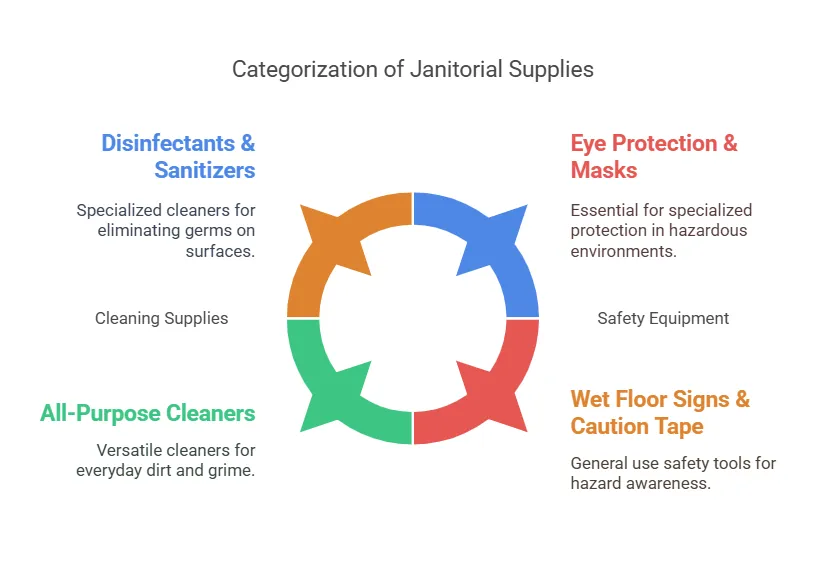
Cleaning Chemicals
- Disinfectants & Sanitizers: Kill germs and bacteria on various surfaces.
- All-Purpose Cleaners: Handle everyday grime and dirt.
- Glass Cleaners: Provide streak-free results for windows and mirrors.
- Floor Care Products: Include strippers, sealants, polishes, and specialized cleaners to protect flooring.
- Green Cleaning Alternatives: Eco-friendly chemicals that minimize harsh fumes and toxins.
Cleaning Tools & Equipment
- Mops & Buckets: Traditional string mops or microfiber mops for enhanced cleaning efficiency.
- Vacuum Cleaners: From upright vacuums to backpack vacuums, designed for different facility types.
- Scrubbers & Polishers: Specialised equipment that helps clean floors more efficiently.
- Cleaning Cloths & Microfiber Towels: Highly absorbent and reusable, reducing the need for paper products.
Paper Products & Dispensers
- Paper Towels & Toilet Paper: Bulk or jumbo rolls can reduce waste and cut costs over time.
- Hand Dryers: Energy-efficient dryers can replace or supplement paper towels in high-traffic restrooms.
- Soap & Sanitizer Dispensers: Automated touchless dispensers can improve hygiene and limit cross-contamination.
Waste Management Supplies
- Trash Bags: Heavy-duty bags suitable for different waste capacities and types.
- Recycling Bins & Compost Bins: Support an eco-friendly waste management strategy.
- Trash Cans: Durable, easy-to-clean receptacles for indoor and outdoor use.
Safety & Personal Protective Equipment (PPE)
- Gloves: Protect hands from chemicals, sharp objects, and biological hazards.
- Eye Protection & Masks: Essential for handling potent chemicals or working in dusty environments.
- Wet Floor Signs & Caution Tape: Helps alert occupants to hazards and prevent accidents.
3. Factors to Consider When Selecting Janitorial Supplies
Safety and Compliance
- Ensure all cleaning chemicals meet local and national health regulations.
- Provide the necessary PPE to employees to comply with occupational health guidelines.
Cost-Effectiveness
- Higher-quality products often clean more efficiently, requiring smaller quantities over time.
- Look for supplier discounts on bulk orders or loyalty programs.
Ease of Use
- Consider user-friendly packaging and clear instructions to reduce training time and errors.
- Opt for ergonomically designed equipment that prevents strain or injury to staff.
Environmental Impact
- Eco-friendly cleaners and tools can reduce chemical emissions and waste.
- Certifications like Green Seal or EcoLogo indicate a product’s environmental credibility.
- Product Compatibility
- Some chemicals may be incompatible and should not be mixed to avoid hazardous reactions.
- Choose supplies tailored to the specific surfaces and materials in your facility.
4. Best Practices for Storing and Managing Janitorial Supplies
Secure Storage Area
- Keep cleaning chemicals in a locked, temperature-controlled space away from food and sensitive materials.
- Store products in clearly labelled containers to prevent accidental misuse.
Inventory Control
- Implement a simple system to monitor stock levels regularly.
- Rotate supplies and use older stock first to avoid expired products.
Proper Labelling and Documentation
- Maintain Safety Data Sheets (SDS) for each chemical product.
- Train employees on the correct handling procedures and possible hazards.
Regular Training
- Offer hands-on training sessions on product usage and safety.
- Keep employees updated on new techniques, equipment, and regulations.
5. Trends & Innovations in Janitorial Supplies
- Sustainable Cleaning Solutions: Growing consumer and regulatory demand has driven innovation in eco-friendly products with natural ingredients and biodegradable packaging.
- Smart Dispensing Systems: Automated dispensers can monitor product usage and send alerts when refills or service are needed.
- Cordless & High-Efficiency Equipment: Battery-operated scrubbers and vacuums increase efficiency and reduce tripping hazards associated with cords.
6. Building a Successful Janitorial Supplies Strategy
A well-thought-out plan for securing and managing janitorial supplies includes:
- Assessing Facility Needs: Determine cleaning frequency, surface types, and peak occupancy periods.
- Creating a Budget: Weigh product quality against cost to find the best long-term value.
- Working with Reliable Vendors: Seek reputable suppliers who offer consistent stock availability and responsive customer service.
- Implementing Continuous Improvement: Solicit feedback from custodial staff, monitor supply usage data, and adjust strategies as needed.
Conclusion
An efficient, reliable, and cost-effective cleaning program hinges on having the right janitorial supplies in place. By focusing on quality, safety, and sustainability, facility managers can ensure their buildings remain clean and inviting while minimizing costs and environmental impact. Stay informed about new products and procedures, and you’ll consistently foster a healthier and more welcoming environment for everyone who steps into your facility.

This post will help the internet visitors for setting
up new web site or even a weblog from start to end.
Hi! I just wish to give you a big thumbs up for your great information you have here on this post.
I am coming back to your blog for more soon.
Fantastic blog! Do you have any suggestions for aspiring writers?
I’m planning to start my own site soon but I’m a little lost on everything.
Would you suggest starting with a free platform like WordPress or go for a paid option? There
are so many choices out there that I’m totally confused ..
Any recommendations? Appreciate it!
Excellent article et très informatif! Les services de marketing médical en ligne offrent
une opportunité incroyable pour les professionnels de santé.
Merci pour le partage de cet article et pour les conseils pratiques!
I absolutely love your blog and find many of your post’s to be precisely what I’m looking for.
can you offer guest writers to write content to suit your needs?
I wouldn’t mind publishing a post or elaborating on most of the subjects you write
about here. Again, awesome weblog!
Excellent web site you’ve got here.. It’s hard to find quality writing like yours these days.
I really appreciate individuals like you!
Take care!!
It is perfect time to make a few plans for the long
run and it is time to be happy. I have read this publish and if I may I desire to suggest you few fascinating things or advice.
Perhaps you can write next articles regarding this article.
I desire to read more issues approximately it!
Hurrah! After all I got a weblog from where I be able to really obtain valuable data regarding my study
and knowledge.
Good day! Do you use Twitter? I’d like to follow you if
that would be okay. I’m absolutely enjoying your blog and look forward to
new posts.
Pretty! This has been an extremely wonderful article.
Thank you for providing these details.
That is very interesting, You are a very professional blogger.
I have joined your feed and stay up for searching
for more of your excellent post. Also, I’ve shared your site in my social networks
You ought to take part in a contest for one of the most useful sites on the net.
I will recommend this web site!
Hey! Quick question that’s completely off topic.
Do you know how to make your site mobile friendly? My blog looks weird when viewing from
my iphone 4. I’m trying to find a theme or plugin that might be able to resolve this problem.
If you have any suggestions, please share. With thanks!
If you would like to improve your experience simply keep visiting this web page and be updated with
the most up-to-date news update posted here.
Have you ever considered about adding a little bit more than just your articles?
I mean, what you say is valuable and all. But think of if you added some great graphics or video clips to give your posts more, “pop”!
Your content is excellent but with images and videos,
this blog could undeniably be one of the greatest in its niche.
Awesome blog!
We’re a gaggle of volunteers and starting a
new scheme in our community. Your website offered us
with helpful info to work on. You have performed an impressive
activity and our whole group might be grateful to
you.
You really make it seem so easy with your presentation but I find this topic to be actually something which I think I would never understand.
It seems too complex and extremely broad for me. I’m looking forward for
your next post, I will try to get the hang of it!
Today, while I was at work, my sister stole my apple ipad and tested to see if it can survive a twenty five foot drop, just so she can be a
youtube sensation. My apple ipad is now broken and she has 83 views.
I know this is totally off topic but I had to share it with someone!
Greate article. Keep writing such kind of info on your page.
Im really impressed by it.
Hey there, You have done an excellent job. I will certainly digg it and in my view
recommend to my friends. I am sure they will be benefited from this website.
Peculiar article, exactly what I needed.
This is very interesting, You’re a very skilled blogger.
I have joined your rss feed and look forward to seeking more of your fantastic post.
Also, I’ve shared your web site in my social networks!
I have read so many articles or reviews concerning
the blogger lovers however this post is genuinely a pleasant
article, keep it up.
Hi there, just became aware of your blog through Google,
and found that it’s truly informative. I’m going to watch out for brussels.
I will be grateful if you continue this in future. Many people will be benefited from your writing.
Cheers!
Active Transportation – view the bike and shared course networks in city Perth and around the state.
Hello there! This is my first comment here so I just wanted to give a quick
shout out and say I really enjoy reading through your articles.
Can you recommend any other blogs/websites/forums that cover the same topics?
Appreciate it!
Paragraph writing is also a fun, if you know after that you can write otherwise it is
difficult to write.
I am curious to find out what blog system you happen to be utilizing?
I’m having some small security issues with my
latest site and I’d like to find something more secure.
Do you have any recommendations?
If some one wishes expert view regarding running a blog after that i suggest him/her to pay
a quick visit this webpage, Keep up the nice work.
My brother recommended I might like this web site. He was totally right.
This post truly made my day. You can not imagine simply how much time I
had spent for this information! Thanks!
Attractive component to content. I just stumbled upon your blog and in accession capital to
say that I acquire actually loved account your blog posts.
Any way I will be subscribing on your augment or even I fulfillment
you get right of entry to constantly fast.
Hi, I check your blog regularly. Your humoristic style is awesome, keep up the good work!
Thanks for finally writing about > Janitorial Supplies: What
Every Facility Manager Needs to Know – Coupontoaster Blog
< Liked it!