


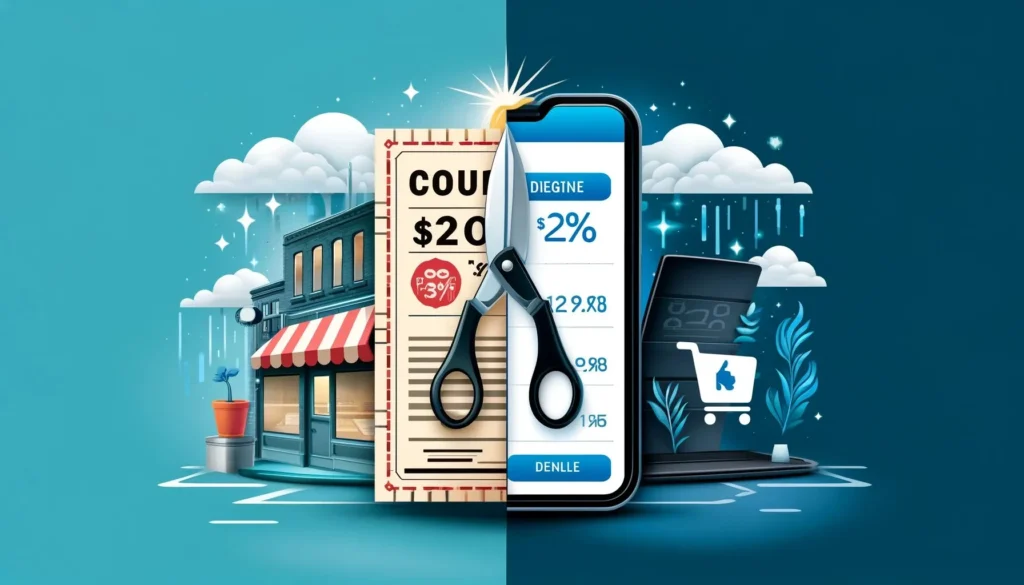
When it comes to marketing tricks, coupons and bonuses are two of the most popular ways companies try to get customers in the door and keep them coming back. Sure, they both aim to get people more involved with a brand, but they work in pretty different ways.
- Coupons offer immediate discounts on purchases, while bonuses provide a wider range of rewards to encourage long-term engagement.
- Coupons are straightforward price reduction tools, whereas bonuses can include additional perks or privileges.
- Businesses use coupons to boost short-term sales and bonuses to foster customer loyalty and repeat purchases.
Coupons are all about giving you a specific discount or deal when you buy something. It could be a code you find online or a physical coupon you can print out – either way, it’s a straightforward way to save some cash on your purchase.
The main perk of coupons is that they lower the price of your transaction right off the bat. You might get a percentage off or a set dollar amount. But there’s usually some fine print involved, like minimum purchase amounts, restrictions on what you can buy, or expiration dates.
At their core, coupons are designed to drive sales ASAP by enticing customers with the promise of saving money. They’re a great tool for boosting revenue and clearing out excess inventory, since they offer a concrete reward at the point of purchase.
Plus, coupons can be used strategically to attract new customers or encourage repeat business from existing ones. And that’s not just in the retail world – even the gaming industry uses coupons to get players in the door.
Contents
Coupons: What Are These For?
With the purchase of a particular good or service, a coupon’s owner is entitled to a particular discount or offer. Whether they can be generated codes you can get online or physical coupons that can be printed, this is a simple way to cut the price of a purchase while it is on sale.
The Evolution of Coupons: From Paper to Digital
- Coupons have come a long way since their inception in the late 1800s, when Coca-Cola first started offering handwritten tickets for free drinks.
- In the early 1900s, printed coupons became more common, with brands like C.W. Post and Kellogg’s using them to promote their products.
- The rise of digital technology has transformed the coupon landscape, with online codes and mobile apps making it easier than ever for customers to access deals.
- Today, digital coupons account for a significant portion of coupon usage. A survey by RetailMeNot found that 75% of consumers have used digital coupons, compared to 63% who have used paper coupons.
The primary benefit of coupons is how quickly they reduce the price of a transaction. For example, it can provide a percentage-based discount or an exact monetary discount. Furthermore, coupons could have terms like minimum purchase amounts or limitations on what can be purchased, and expiration dates.
- In 2020, Honey, a browser extension that automatically applies coupons at checkout, was acquired by PayPal for $4 billion. The acquisition highlighted the growing value of coupon technology in e-commerce.
- Retailers like Target and Walmart have integrated digital coupons into their mobile apps, making it easy for customers to save on their purchases. Target’s Cartwheel app, which offers personalized deals and coupons, has been downloaded over 40 million times.
Coupons’ main purpose is to increase sales right away by attracting customers with the prospect of financial savings. These are effective instruments for increasing the amount of sales and getting rid of extra inventory because they offer real rewards when you make a purchase.
Additionally, coupons can be used carefully to draw in new clients not just in the realm of business but also in gaming. It encourages old ones to come back or promote repeat usage from current customers.
Defining Bonuses
Unlike coupons, which are all about discounts, bonuses can include a whole range of rewards designed to keep customers engaged and loyal.
In the world of online gaming, a bonus is a specific type of incentive that gives players extra funds or chances to play. It’s usually tied to a specific action or transaction within the game. While bonuses can sometimes include discounts similar to coupons, they often come with additional perks or privileges.
Bonuses can take many forms – they might be free gifts, access to exclusive amenities, loyalty points, or cashback rewards. And unlike coupons, which provide instant gratification at the point of sale, bonuses often involve longer-term incentives that accumulate over time or are unlocked when certain conditions are met.
The key thing that sets bonuses apart is that they’re designed to encourage ongoing engagement and build long-term relationships with customers. A retailer might offer bonus points for every dollar spent, which can then be redeemed for free products or other perks.
In the world of iGaming, one particular kind of incentive that gives gamers extra money or chances to play games is also a bonus. It’s frequently connected to a gameplay action or transaction. Although bonuses sometimes come with savings similar to those found in coupons, they also come with additional advantages or privileges. In this website, for instance, features expert reviews of different bonuses to aid players in making informed decisions.
Bonuses can take many different forms; they can be gifts or membership to exclusive amenities, or they can be reward points and cashback benefits. In contrast to coupons which provide immediate satisfaction at the beginning of the sale, bonuses may entail prolonged incentives that mount up gradually or only become available if specific requirements are met. Bonuses are distinctive because they serve as a means of encouraging purchases and fostering long-term client connections. For example, a merchant might give bonus points for each dollar spent, which might then be exchanged for free goods or other benefits.
How Businesses are Using Bonuses to Drive Growth
- Many credit card companies offer sign-up bonuses to attract new customers. Chase Sapphire Reserve, for example, offers 60,000 bonus points (worth up to $900 in travel) when you spend $4,000 in the first three months.
- Loyalty programs like Starbucks Rewards give customers stars (points) for every purchase, which can be redeemed for free drinks or food. Starbucks Rewards members account for over 50% of the company’s total sales.
- Online gaming platforms use bonuses to keep players engaged and encourage them to make in-game purchases. Zynga Poker, for instance, offers daily bonuses and rewards for completing certain challenges or playing a specific number of hands.
- Retail brands like Sephora and Ulta offer tiered loyalty programs that give customers points for every purchase, which can be redeemed for discounts or exclusive products. These programs have been hugely successful in driving customer retention and spending.
By understanding the differences between coupons and bonuses, savvy shoppers can make informed decisions to maximize their savings and benefits.
When faced with these types of incentives, it’s important to consider not just the immediate discount offered by a coupon, but also the long-term value and utility of bonuses.
You should also pay attention to any terms and conditions associated with these promotions, such as redemption requirements or restrictions, before taking advantage of them.
Smart consumers can also benefit from the complementary nature of coupons and bonuses by strategically combining them to optimize their rewards and savings.
For example, pairing a coupon code for an instant discount with a bonus that offers cashback or reward points could result in significant benefits that provide both immediate satisfaction and long-term value.
Enhancing Customer Options
Equipped with an advanced understanding of the distinctions between discounts and bonuses, you as a customer can make well-informed choices to maximize your financial gains and advantages. When offered with such incentives, it’s necessary to take note of both the long-term significance and usefulness of bonuses in addition to the initial discount offered by coupons.
Before utilizing any marketing incentives, you should also consider things like redemption conditions and any related terms and rules. Additionally, intelligent consumers can take benefit of the complimentary qualities of incentives and coupons by carefully blending them to maximize their benefits and savings.
Combining a promotional code for a single discount with a bonus that offers cashback or reward points, for example, might result in significant advantages that offer both instant satisfaction and future advantages.
Conclusion
Coupons and bonuses are both powerful tools for driving customer engagement and sales – but they work in different ways. By understanding the unique benefits of each, businesses can create more effective marketing strategies, and consumers can make smarter decisions about where to spend their hard-earned cash.
Once customers understand the minor distinctions between coupons and bonuses, they can confidently navigate the constantly changing world of discounts and incentives. They can make the most out of their buying power and maximize the benefits provided by merchants and companies.