


As a sincere and committed employee or homemaker, there’s no doubt that you’re putting in the effort and time into achieving your goals and working efficiently. Over the years you have probably developed your own way to tackle the daily routine, and also deal with the ups and downs, and handle the occasional crisis that comes your way. There are times when you work best on your own, but there are other situations where you need the support of a team.
Underlying all this is your own work philosophy and your own unique style of working. However, like everyone else, you may have fallen into a groove, developed certain habits and set ways to tackle tasks. Perhaps it’s time to take stock and check whether there is anything you can change, improve or eliminate in order to work more efficiently. More importantly, is there something you can do to protect your mental and physical health while you achieve your goals, so that you can avoid burnout?
This is where work timers come in. They’re simple tools, but they can make a big difference in how you work and how much you get done.
Contents
What are work timers?
Work timers are just what they sound like – timers you use while working. But they’re not about rushing you. Instead, they help you focus and take breaks. The most popular one is called the Pomodoro Technique, but there are others too.
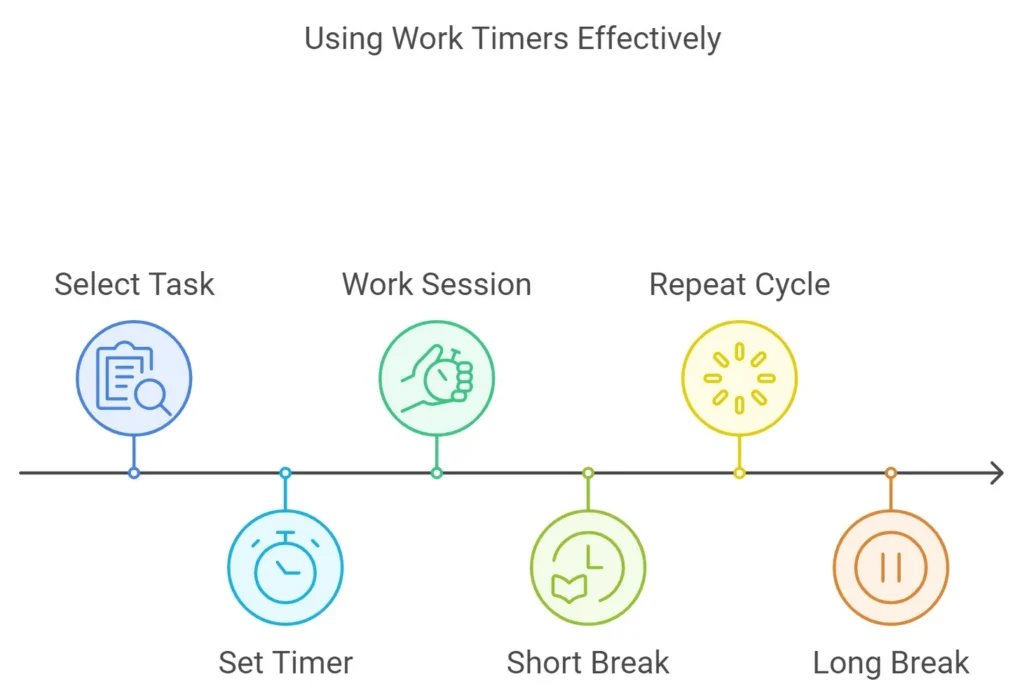
Here’s how a basic work timer system works:

- Pick a task you need to do.
- Set a timer for 25 minutes.
- Work on your task until the timer goes off.
- Take a 5-minute break.
- After four of these cycles, take a longer break (15-30 minutes).
How to start using work timers
- Start small. Try one 25-minute work session and see how it feels.
- Use a real timer, not just the clock. Your phone probably has a timer app, or you can find free ones online.
- During your work time, focus on one task. Don’t check emails or social media.
- Actually take your breaks. Get up, stretch, or get a drink of water.
- Adjust as needed. If 25 minutes is too long or short for you, change it. The point is to find what helps you work best.
Making work timers fit your style
Remember, work timers are tools to help you, not strict rules. Here’s how to make them work with your style:
- If you work best alone, use timers for solo tasks.
- If you’re part of a team, suggest trying timers for group work sessions.
- For homemakers, use timers to tackle cleaning tasks or organize your day.
- If you have a flexible schedule, use timers to create structure in your day.
By using work timers, you can improve how you work without changing everything about your style. They help you focus when you need to, but also remind you to take breaks. This way, you can get more done and still protect your health.
Real-life examples of using work timers
A working mom’s morning routine
Let’s say you’re a mom with a full-time job and kids to get ready for school. Your mornings used to be chaos. You’d rush around, trying to make breakfast, pack lunches, get the kids dressed, and somehow get yourself ready for work. Most days, you’d end up running late, feeling stressed before you even got to the office.
Then you decided to try work timers. Here’s what you did:
- You set a timer for 10 minutes to make breakfast.
- Another 10-minute timer for packing lunches.
- A 15-minute timer for getting the kids dressed and ready.
- A final 15-minute timer for your own getting-ready routine.
What happened? At first, it felt weird. You kept checking the timer, worried you wouldn’t finish in time. But after a few days, something changed. You started focusing more on the task at hand instead of worrying about everything else. You realized you could actually make breakfast in 10 minutes if you weren’t constantly running off to do other things.
The kids even got into it. They started trying to beat the “getting dressed” timer, turning it into a game. And you? You found yourself with extra time most mornings. No more running into the office with your hair still wet. You even had time to sit and have coffee some days.
The timers helped you see where you were wasting time and where you needed to focus. They turned your crazy mornings into a manageable routine. And the best part? You started your workday feeling calm and prepared instead of frazzled and stressed.
A 19-year-old student’s study habits
Now, imagine you’re 19 years old, in college, trying to balance classes, homework, a part-time job, and a social life. You’ve got a big paper due, but every time you sit down to work on it, you end up scrolling through social media or watching videos online. Before you know it, hours have passed and you’ve barely written a paragraph.
You heard about work timers and decided to give them a shot. Here’s what you did:
- You set a timer for 25 minutes and told yourself you’d work on your paper until it went off.
- When the timer rang, you set another one for a 5-minute break.
- You repeated this cycle four times, then took a longer 30-minute break.
What happened? The first 25 minutes were tough. You kept wanting to check your phone. But you told yourself, “It’s just 25 minutes. I can do anything for 25 minutes.” So you stuck with it.
To your surprise, by the end of that first 25 minutes, you’d written more than you usually did in an hour. The 5-minute break felt good, and you were actually eager to get back to writing when the next 25-minute session started.
After a few cycles, you realized something: those social media checks and video watches weren’t making you happy. They were just habits. But seeing your paper grow? That felt great.
You started using timers for other homework too. Sometimes you’d do 15-minute timers for quick tasks, or 40-minute ones when you really needed to focus. Your grades started improving, and you found yourself with more free time because you weren’t wasting hours on fake “study sessions” that were really just procrastination.
The timers helped you build better study habits. You learned to focus intensely for short periods, which turned out to be way more effective than trying to study for hours while distracted. Plus, you still had time for friends and fun, because your work was getting done faster and better than before.
These are just two examples of how work timers can help in real life. Whether you’re juggling family and work, or trying to stay focused as a student, timers can be a simple but powerful tool to help you get stuff done and feel good about it.
What Does “Working Efficiently” Mean?
In real terms, efficiency means that you use the minimum amount of effort, costs, time and resources and yet increase your productivity and output. It means that you don’t waste any of these components, whether they are physical or mental. To achieve higher efficiency, you need to shift from your current mode of working, view it from a fresh perspective, and look for creative and innovative ways to achieve the same results.
Being more efficient gives you more job satisfaction, makes you more valued, and boosts your self esteem. You could find yourself donning the role of “expert” and have people coming to you for advice. You become more productive, and yet have enough spare time to spend with loved ones, and enjoy your leisure, interests and hobbies.
People who develop more efficient ways to complete their tasks work smarter and not necessarily harder. In some cases, you may not be in control over certain aspects of the task, and there may be mandatory processes that you have to follow. In such cases, you can still achieve maximum efficiency by tweaking a few things and making minor yet significant changes in the routine.
Maximize Efficiency: Tips and Tricks
- Scheduling: No matter what the task, creating a firm schedule ensures time management, cuts time wasted in decision-making, helps to prioritize, and helps to instill positive work habits.
- Time Management: Use a work timer to help you complete your task within the estimated time. Timers ensure that tasks are broken up into smaller steps and they can reduce anxiety and stress because they give you a feeling of being in control. Whether you’re a student, homemaker, employee or business head, using a simple device such as a Pomodoro timer can work wonders for your efficiency and time management.
- Use Apps: While it’s a good idea to disconnect from digital devices occasionally, there are some great apps available that can help you stay on top of the task. Find apps that fit your working style, task at hand, and the requirements of the job.
- Avoid multitasking: There are many who tout the glories of multitasking, but truth be told, today the mantra is “monotasking.” Experts opine that it makes for higher focus and concentration, and helps you to get into the Flow Zone, where you work most efficiently, naturally and joyously.
- Learn to De-Stress: Any time you feel overwhelmed, ensure that you know how to relax. This takes practice, because you first have to recognize the signs of being on the burnout path. Once you sense the symptoms, de-stress by deep breathing, taking a break or a short walk, listening to your favorite music, staying hydrated, and performing basic stretching exercises.
- Ask For Support: There are times when you’re just stuck without knowing how to complete the task. At such moments, having the right kind of help can work wonders. However, build your support system when you aren’t in a crisis so that when the occasion arises, you have it ready for you. This means that you have to be a friend in need to others too. Offer your support when it’s asked for, and avoid jumping in with unsolicited advice. Don’t keep track of who helped whom, and instead, practice being in the moment, with kindness and gratitude.