



Every year, new health trends pop up. Some focus on food, others on workouts, and many involve buying expensive products. While a few trends are worth trying, most disappear as quickly as they arrive. People jump on these ideas, hoping for something life-changing, but many end up being a waste of time and money.
Instead of following every new health craze, it makes more sense to focus on what actually works. Some things, like eating a balanced diet or staying active, are useful no matter the year. Others, like extreme diets or overpriced wearables, are just clever marketing. Knowing the difference helps make good choices without falling for every new fad.
Contents
- 1 Understanding What Works and What’s Just Hype
- 2 Following A Simple Routine
- 3 Switch Your Drinks, Save Your Health (and Cash)
- 4 Walking: The Exercise Nobody Admits Counts
- 5 Don’t Shop Hungry – Your Brain Can’t Handle It
- 6 The Night Eating Disaster
- 7 Vegetables That Don’t Taste Like Punishment
- 8 Trendy Diets vs. Sustainable Eating Habits
- 9 The Cost of Following Every New Trend
Understanding What Works and What’s Just Hype
Some health advice never goes out of style because it actually makes sense. Eating real food, moving your body, and getting enough sleep have always been good choices. These habits stick around because they work in everyday life. On the other hand, trends like juice cleanses, detox teas, or miracle diets show up out of nowhere and fade just as fast.
Social media plays a big role in making trends popular, but just because something is everywhere doesn’t mean it’s good. Some trends are designed to just sell products. Before trying something new, it’s better to check if it’s backed by experts or just another short-lived craze.
Following A Simple Routine

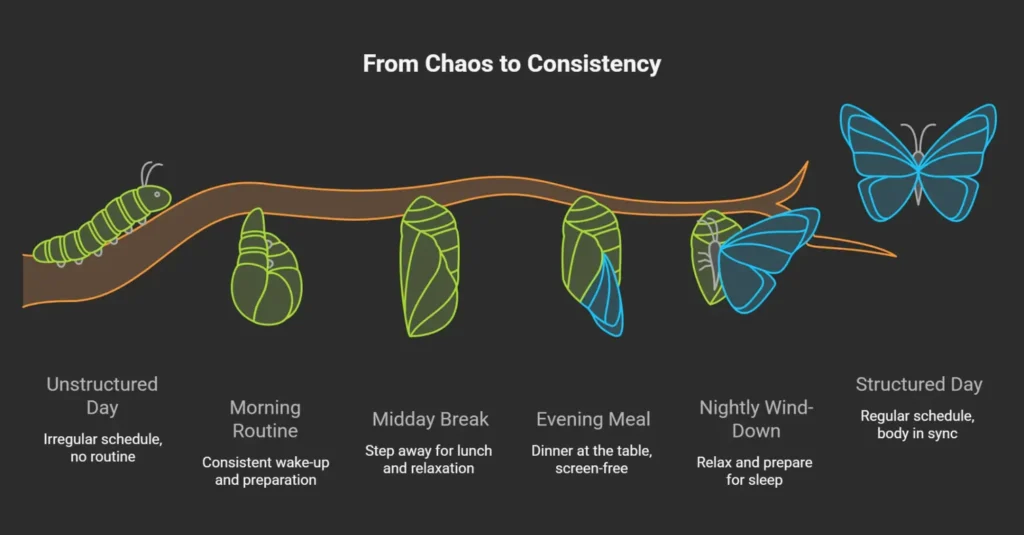
Your grandmother didn’t need productivity apps. She woke up, ate breakfast, worked, ate lunch, worked more, had dinner with family, then went to bed. No life hacks. No optimization.
The power wasn’t in what she did – it was in doing it consistently. Same breakfast time whether it was Tuesday or Saturday. Body knew what to expect.
Here’s what a basic human routine looks like stripped of modern nonsense:
Morning (6-9 AM)
- Wake up within the same 30-minute window daily
- 10 minutes to actually wake up – sit on the bed edge, stretch, whatever
- Bathroom, wash face, brush teeth (15 minutes)
- Breakfast – actual food, not grabbed on the run (20 minutes minimum)
- Get ready without rushing (30 minutes)
Midday (12-1 PM)
- Lunch break means break – step away from whatever you’re doing
- Eat for 20 minutes, then 10-20 minutes of nothing
- Walk around, sit outside, just don’t work through it
Evening (6-8 PM)
- Dinner happens at a table, not in front of screens
- 30 minutes minimum for eating
- 15 minutes to clean up – doing dishes counts as movement
Night (9-11 PM)
- Wind-down starts 1 hour before sleep
- No new problems or decisions after 9 PM
- Same bedtime within 30 minutes, every single night
That’s it. No special equipment. No subscriptions. Just doing basic human things at regular times so your body stops fighting you.
A simple routine also builds habits that feel natural. Whether it’s eating meals at regular times, going for a daily walk, or setting aside time to unwind, consistency keeps things balanced. You can add wellness products to your wellness routine without making things complicated.
For instance, you can use supplements from brands like USANA Health Sciences to help maintain a simple wellness routine. They do not replace any dietary plan but help complement it, which is what a simple routine entails. Likewise, you can try Zumba at home to make your fitness routine fun. It’s all about keeping things simple yet fun.
Switch Your Drinks, Save Your Health (and Cash)
Americans drink about 39 gallons of soda per year. That’s roughly 7,500 spoonfuls of sugar just from soft drinks. The fix isn’t complicated – drink water with meals instead.
A 2019 Virginia Tech study tracked 48 adults who replaced one sugary drink daily with water. They lost an average of 4 pounds in six months without changing anything else. The researchers published this in Human Nutrition and Metabolism journal, finding that participants naturally consumed 200 fewer calories daily just from this switch.
Water costs nothing from the tap. A daily Coke habit runs you $730 annually. Two sodas? You’re looking at $1,460. That’s a vacation fund, not a beverage budget.
The phosphoric acid in cola drinks interferes with calcium absorption – Harvard’s School of Public Health documented this connection to decreased bone density in their Framingham Osteoporosis Study. Women who drank three or more colas weekly had 4% lower bone density at the hip. Your skeleton literally weakens while you sip.
Walking: The Exercise Nobody Admits Counts
Forget the 10,000 steps myth. That number came from a 1960s Japanese pedometer marketing campaign – “manpo-kei” literally means “10,000 steps meter.” No science behind it.
What actually matters: movement throughout the day beats one gym session. Dr. Keith Diaz’s Columbia University research, published in the Annals of Internal Medicine (2023), followed 7,999 adults for four years. Those who walked just 2,337 steps daily – that’s 20 minutes – reduced their risk of dying by 30% compared to sedentary adults.
Twenty minutes. Not an hour on the treadmill.
The brain benefits hit faster than weight loss. Stanford researchers found that walking increases creative output by 60% – they tested 176 college students in their 2014 study “Give Your Ideas Some Legs.” Steve Jobs held walking meetings. Charles Dickens walked 20 miles daily through London. They weren’t exercising; they were thinking.
- Walk to the corner store instead of driving (8-minute round trip = 800 steps)
- Take phone calls standing and pacing (average call = 500 steps)
- Park at the far end of lots (adds 200 steps each way)
- Use the bathroom one floor up at work (50 steps per trip, adds up to 400 daily)
University of East Anglia study of 18,000 British commuters found that those who walked to work had 45% better mental health scores than drivers.
Your knees actually get stronger from regular walking – cartilage needs movement to stay healthy. The Arthritis Foundation cites multiple studies showing walking reduces arthritis pain by lubricating joints and strengthening surrounding muscles. Sitting all day starves your cartilage of nutrients.
Don’t Shop Hungry – Your Brain Can’t Handle It
Yale neuroscientists scanned people’s brains while food shopping. Hungry shoppers showed 20% more activity in the orbitofrontal cortex – the brain’s reward center. You’re literally high on hunger. Decision-making tanks.
Researchers at University of Minnesota had 68 participants shop online either hungry or full. Hungry shoppers bought 44% more high-calorie foods. But here’s the weird part – they also bought more non-food items. Binder clips. Staplers. USB drives. Hunger makes you acquire everything.
The hormone ghrelin peaks when you’re hungry. It doesn’t just signal hunger – it impairs impulse control. A study in Psychoneuroendocrinology showed ghrelin injections made people choose immediate rewards over better delayed rewards. Your hungry brain becomes a toddler.
Shop an hour after eating. Ghrelin drops. Leptin rises. Your prefrontal cortex – the adult in your brain – takes back control. You buy vegetables instead of family-size Oreos.
The Night Eating Disaster
Eating then immediately sleeping is asking for trouble. Your lower esophageal sphincter – the valve keeping stomach acid down – relaxes when you lie flat. Add a full stomach pressing against it, and acid creeps into your esophagus. That’s your 2 AM heartburn.
Dr. Jamie Koufman’s research on reflux disease found that people who ate within 3 hours of bedtime had 7.5 times higher risk of esophageal cancer. The acid literally changes your cell structure over time. Your metabolism doesn’t stop at night – that’s myth. But insulin sensitivity drops by 25% in the evening according to research from University of Surrey. Same meal at 8 PM versus noon causes 20% higher blood sugar spike. Your body handles food worse at night, period.
The fix: 2-3 hours between last bite and lying down. Walk around the block after dinner. Do dishes. Fold laundry. Gravity keeps food moving the right direction while your stomach does its job.
Vegetables That Don’t Taste Like Punishment
Brussels sprouts contain glucosinolates – compounds that literally taste bitter to 70% of humans due to the TAS2R38 gene variation. You’re not weak for hating them. You’re genetically programmed to.
But roast those same sprouts at 425°F and the Maillard reaction creates over 600 flavor compounds. The sugars caramelize. The edges crisp. Same vegetable, completely different food. No $12 green juice required.
Broccoli delivers 220% of your daily vitamin C per cup – more than oranges. The sulforaphane in it switches on your body’s antioxidant production for 72 hours after eating. One serving keeps working for three days. Toss it with garlic and olive oil, roast for 20 minutes. Tastes like restaurant food.
Cherry tomatoes contain lycopene levels that increase by 35% when cooked – your body absorbs it better. Pop them in the oven until they burst. They’re literally concentrated umami bombs. Kids eat them like candy because they basically are – 4 grams of natural sugar per 100g serving.
The average American spends $1,200 yearly on supplements while eating 1.5 cups of vegetables daily. The recommended amount is 3 cups. Just eating regular vegetables would save money and deliver nutrients in forms your body actually recognizes.
Trendy Diets vs. Sustainable Eating Habits
Every January, millions start keto. By February, maybe 80% have quit. The diet industry banks $72 billion yearly on this cycle of failure and fresh starts.
Mediterranean populations eat bread, pasta, and drink wine daily – yet live longer than Americans counting macros. Japanese centenarians in Okinawa eat white rice at every meal. The French eat butter with everything. None of them are tracking calories on apps.
What actually works: eating regular food in normal amounts at predictable times. Revolutionary.
Cornell’s Food Lab found that people make 227 food decisions daily. Most happen unconsciously. You can’t willpower your way through 227 decisions. But you can set up patterns that make most of those decisions automatic.
The Cost of Following Every New Trend
Health trends often come with a price tag. Whether it’s expensive products, high-tech gadgets, or costly fitness programs, keeping up with the latest fads can get expensive fast. The problem is that many of these trends don’t actually lead to better results. People spend money hoping for big changes, only to realize later that they don’t need half the things they bought.
Before jumping into the latest health craze, it helps to ask if it’s really worth it. Some trends are just clever marketing designed to sell products. Being selective about what’s actually useful prevents unnecessary spending. Health shouldn’t have to come with a high price.
Every year brings new health trends, but not all of them are worth following. Some changes are practical and easy to stick with, while others are just fads. Avoid getting caught up in what’s popular, as focusing on what actually works can yield better outcomes. Good choices aren’t the ones that require constant adjustments but the ones that naturally fit into everyday life.