



Is your current mortgage still the best fit for you? Could you be paying less each month? Many homeowners don’t realise when they could benefit from a new loan arrangement. Circumstances change, and so do interest rates, lender policies, and personal finances. Knowing when to make a switch can lead to substantial savings and better financial stability.

Contents
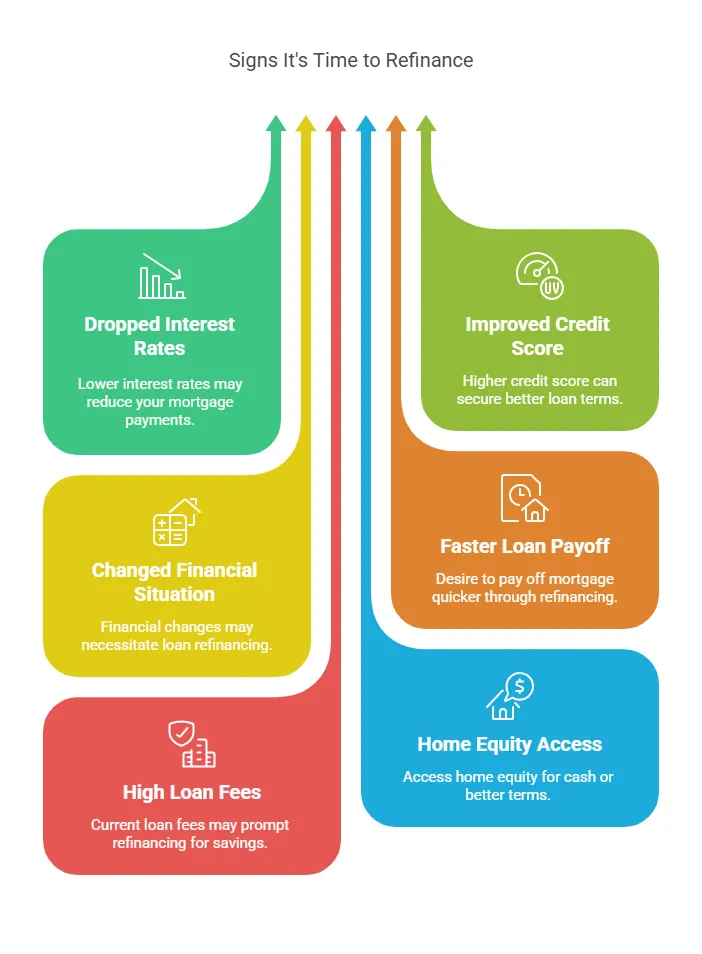
Interest Rates Have Dropped
You may refinance your home loan if market interest rates have dropped significantly since you first took it out. One of the biggest reasons to consider a new loan structure is falling rates, as even a small decrease can reduce monthly payments and lead to long-term savings. Switching to a lower rate can improve financial flexibility, but it’s important to calculate potential costs, such as exit fees, before making a decision. Weigh the benefits against any fees to ensure refinancing is the right financial move for you.
Let’s say you got your mortgage when rates were at 5%. You borrowed $300,000 for 30 years. Your monthly payment is about $1,610 just for principal and interest. Now rates have dropped to 4.5%. Same loan, new rate: your payment would be around $1,520. That’s $90 less every month, which adds up to $1,080 saved per year. Over the full 30 years? You’d save $32,400.
But watch the closing costs. If refinancing costs you $4,000 in fees, you’ll need about 44 months (just over 3.5 years) to break even. Planning to stay in your home at least 4 years? Then it makes sense. Moving sooner? Probably not worth it.
The math gets even more compelling with bigger drops. If rates fall from 6% to 4.5%, on that same $300,000 loan, you’d save $272 monthly. That’s $3,264 yearly and nearly $98,000 over the full loan term. Your break-even point on a $4,000 refinance comes much faster – just 15 months
Your Credit Score Has Improved
A stronger credit score can unlock access to more competitive loan terms, leading to potential savings. If financial habits have improved over time, lenders may offer lower interest rates, reduced fees, or more flexible repayment options.
You bought your house with a credit score of 660. That put you in the “good but not great” category, and the bank charged you 5.2% interest. Fast forward two years – you’ve paid every bill on time, paid down some credit cards, and now your score is 740.
That jump from “good” to “very good” could get you a rate of 4.7% today. On a $300,000 loan, that drops your payment from $1,650 to $1,560, saving you $90 monthly or $1,080 yearly.
Even better, with the higher credit score, you might qualify for lower closing costs or fewer points upfront. Lenders might waive some fees they charged you the first time around when they saw you as a higher risk.
Remember, every 20-point improvement in your score can meaningfully change your rate offers. If you were at 620 when you bought (paying maybe 5.8%) and now you’re at 700, your potential savings are even bigger.
Borrowers who initially took out a mortgage with a lower credit score may now qualify for significantly better conditions. Regularly reviewing credit scores and comparing loan options can help determine whether refinancing to a more favourable deal is a smart financial move.
Your Financial Situation Has Changed
- Life’s Unpredictability and Financial Changes
Financial situations can shift due to various life events. A sudden promotion, inheritance, or business success may provide extra funds, while unexpected challenges like job loss or medical expenses may create financial strain. - Opportunity to Pay Off a Loan Quicker
With increased income, refinancing to a shorter loan term can reduce interest costs and help you become debt-free sooner. Making extra payments or switching to a lower interest rate can maximise long-term savings. - Need for Lower Monthly Payments
During financial difficulties, extending the credit term or securing a lower rate can reduce monthly payments. This improves cash flow and ensures better financial stability during uncertain times. - Aligning Loans with New Realities
Adjusting a loan based on changing financial conditions allows better control over repayments. Refinancing can provide flexibility, peace of mind, and a structure that aligns with current income and expenses.
You Want to Pay Off the Loan Faster
Some homeowners aim to pay off their mortgage sooner to achieve financial freedom. If extra funds are available, refinancing to a shorter loan term can significantly reduce overall interest costs. While higher monthly repayments may seem challenging, they lead to quicker debt elimination and long-term savings.
Some homeowners aim to pay off their mortgage sooner to achieve financial freedom. If extra funds are available, refinancing to a shorter loan term can significantly reduce overall interest costs. While higher monthly repayments may seem challenging, they lead to quicker debt elimination and long-term savings. Evaluating different loan structures helps determine if this strategy aligns with financial goals. A well-planned approach can provide greater peace of mind and a more secure financial future.
Here’s a real example: You’ve got a $300,000 loan at 4.5% with 25 years left. Your monthly payment is $1,667. You get a promotion with a $15,000 salary bump and decide to refinance to a 15-year loan at 4.25% (shorter terms often get better rates).
Your new payment jumps to $2,266 – that’s $599 more each month. Sounds like a lot, but look what happens:
- Original loan: 25 more years of payments totaling $500,100
- New 15-year loan: Total payments of $407,880
By paying $599 more monthly, you save $92,220 in total and get out of debt 10 years sooner.
Advantages:
- You build equity much faster, giving you more financial security in economic downturns.
- You save tens of thousands in interest payments that you can redirect to retirement or other investments.
- You eliminate your largest monthly expense a decade earlier, creating breathing room for other life goals or early retirement.
- Your debt-to-income ratio improves faster, making it easier to qualify for other loans if needed.
- You gain psychological freedom from not having mortgage payments hanging over you for an extra decade.
- You create a forced savings plan that builds wealth through home equity rather than potentially spending that money elsewhere.
- You protect yourself against the temptation to refinance repeatedly and extend your debt horizon indefinitely.
Evaluating different loan structures helps determine if this strategy aligns with financial goals. A well-planned approach can provide greater peace of mind and a more secure financial future.
Your Current Loan Has Too Many Fees
Not all credits offer the same financial benefits, and some come with high fees that diminish savings over time. Costly annual charges, ongoing service fees, or penalties for early repayments can make a loan unnecessarily expensive. Refinancing a loan with lower or fewer fees can help reduce overall costs and improve financial efficiency. Regularly comparing lender terms ensures that the current loan remains cost-effective and aligned with financial goals, ultimately maximising long-term savings.
You Want to Tap into Your Home Equity
- Tapping into Increased Property Value
If your home’s value has risen, you can unlock additional funds through a new loan. This allows homeowners to access equity without selling their property. - Using Equity for Major Expenses
The funds can be used for home renovations, purchasing an investment property, funding education, or covering large unforeseen expenses. This makes home equity a valuable financial tool. - Structured Loan for Flexibility
Refinancing with a well-planned loan structure ensures you access funds while keeping repayments manageable. A lower interest rate or extended term can help maintain financial stability. - Creating More Financial Opportunities
Leveraging home equity strategically can open doors to wealth-building investments or necessary expenses. Proper financial planning ensures benefits outweigh risks.
You Need More Flexible Loan Features
Some loans come with valuable features that enhance convenience and provide potential savings. Options such as offset accounts, redraw facilities, and extra repayment flexibility can help borrowers reduce overall interest costs and pay off their loans faster. An offset account links to the mortgage, reducing the interest charged by offsetting the credit balance.
Redraw facilities allow access to extra payments when needed, offering financial flexibility. Making additional repayments can shorten the loan term and decrease the total interest paid. If a current loan lacks these benefits, refinancing to a more flexible structure may improve financial management and long-term savings.
Knowing when to refinance your home loan can be a game-changer. Whether it’s securing a lower interest rate, adjusting to a new financial reality, or reducing unnecessary fees, the benefits can be significant. Timing and research are key to making the right move. Exploring options and seeking expert advice can help ensure that any decision made is financially sound and beneficial in the long run.